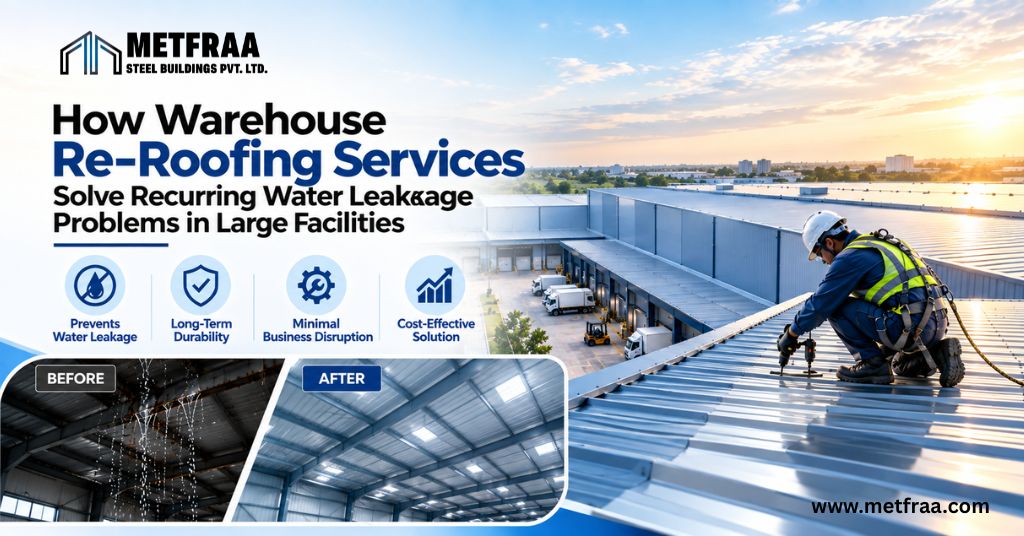
Warehouse Re-Roofing Services can become essential when a large facility continues to experience water leakage even after repeated repair work. For an industrial warehouse, leakage is rarely just a roofing inconvenience. It can interfere with storage, production, material handling, electrical systems and regular facility operations.
At Metfraa Steel Buildings, we work on re-roofing and structural restoration projects for existing industrial buildings where ageing roofing systems, recurring leakage and deterioration have become difficult to manage through isolated repairs. Our approach is to first understand the condition of the existing roof and then determine the appropriate scope of re-roofing, restoration or related structural work. This helps address the actual roofing problem rather than simply treating the point where water happens to appear.
The important question for a facility owner is therefore not only “Where is the water coming in?” but also “Why does the roof keep allowing water to enter?”
Why Does Water Leakage Keep Returning in Large Warehouses?
For large facilities, Warehouse Re-Roofing Services can help address recurring leakage when ageing roofing components can no longer be effectively managed through isolated repairs. Over time, these conditions can affect not only the roofing sheets but also the components that connect and protect them.
Recurring leakage can develop because of several conditions, including:
- Ageing or deteriorated roofing sheets
- Corroded roof surfaces
- lose or damaged fasteners
- Failed sheet overlaps
- Deteriorated sealants
- Damaged flashing
- Poorly functioning gutters
- Blocked or inadequate drainage paths
- Leakage around roof penetrations
- Deterioration around roof junctions
The visible leak inside the warehouse may not always identify the actual point where rainwater entered. Water can travel along sheets, joints or structural members before becoming visible inside the building.
This is one reason why repeatedly repairing the same visible location may not always solve a recurring leakage problem.
Why Repeated Roof Repairs May Not Solve the Root Problem
A small, isolated leak can often be addressed through targeted repair. The situation becomes different when leakage occurs at several locations across an ageing roof.
Imagine a warehouse where one leakage point is repaired before every monsoon. A few months later, another section begins leaking. The new location is repaired, but another weak point appears later.
The problem may no longer be one damaged section.
It may indicate that the roofing system has reached a stage where multiple components are deteriorating.
Continuing with individual repairs without assessing the wider roof condition can make maintenance reactive. Every new leakage point becomes another repair requirement.
A broader roofing assessment can help determine whether the existing system is still suitable for continued repairs or whether re-roofing should be considered.
How Warehouse Re-Roofing Services Address Recurring Leakage
Warehouse re-roofing involves more than simply removing an old sheet and installing a new one. The condition of the existing roofing system needs to be understood before deciding how the work should be executed.
Assessing the Existing Roofing Condition
The first stage is to examine the roof and identify visible deterioration.
The assessment may include:
- Roofing sheet condition
- Corrosion levels
- Fasteners and fixing points
- Sheet overlaps
- Flashings
- Ridge areas
- Roof penetrations
- Gutters and downpipes
- Accessible purlins and supporting members
This assessment is an important first step in planning Warehouse Re-Roofing Services, particularly when leakage affects multiple areas of an ageing roof.
Identifying the Actual Leakage Sources
A leak visible inside the warehouse does not necessarily mean that the roofing sheet directly above it is damaged.
Water can move through joints and roof components before entering the internal space.
Therefore, identifying recurring leakage requires attention to the complete roof assembly rather than focusing only on the point where water is noticed.
Replacing Deteriorated Roofing Sheets
When roofing sheets have extensive corrosion, damage or deterioration, continuing to patch individual areas may not provide the required level of protection.
The selection of suitable roofing sheets and related accessories also plays an important role when replacing an ageing roof. Depending on the building requirements, industrial roofing sheets and accessories can be selected based on factors such as profile, coating, thickness and fixing requirements.
Re-roofing allows deteriorated sheets to be replaced as part of a planned project.
The replacement method can be developed according to the existing building configuration, roof geometry, structural condition and operational requirements.
Improving Fastening and Joint Details
Roofing performance depends heavily on how sheets are connected and sealed.
During re-roofing, fasteners, overlaps and joint conditions can be reviewed so that vulnerable areas are not simply carried forward into the renewed roofing system.
Addressing Flashing and Roof Junctions
Some recurring leaks originate around locations where different building elements meet.
These can include:
- Roof-to-wall junctions
- Ridge areas
- Roof edges
- Sheet transitions
- Openings and penetrations
- Equipment interfaces
These areas require careful attention because even a relatively small opening can allow significant water entry during heavy rainfall.
Drainage Is Part of the Leakage Solution
A roof can have good-quality sheets and still experience water-related problems if rainwater is not discharged effectively.
Large warehouse roofs can collect substantial volumes of rainwater during intense rainfall. Gutters, downpipes and drainage routes therefore form an important part of the overall roofing system.
During re-roofing, drainage conditions can be reviewed along with the roof itself.
Metfraa’s re-roofing service specifically includes drainage planning and ridge and gutter optimisation as part of its approach to roofing upgrades.
This is important because replacing roofing sheets without considering how rainwater leaves the roof may leave another potential source of future problems unaddressed.
What About the Existing Steel Structure?
Roofing problems and structural problems should not always be considered separately.
An older warehouse may have supported steelwork that has also been exposed to moisture and environmental conditions for many years. Corrosion or deterioration of purlins and other accessible structural components can affect the way roofing work needs to be planned.
Before major re-roofing work, the condition of the supporting system should therefore be considered.
If replacement, strengthening or modification of structural components is required, the availability of suitable structural steel sections for industrial applications can also become an important part of project planning.
How Metfraa Approaches Existing Industrial Buildings
Not every roofing project begins with a new building.
Many industrial facilities already have an existing structure that needs to continue serving its purpose. In these situations, completely replacing the building may not be the only route being considered.
Metfraa Steel Building Structural Restoration & Re-Roofing service is designed around this type of requirement. The company provides re-roofing along with structural re-strengthening, painting and surface protection, dismantling and erection, and old-structure revamping.
Its re-roofing scope includes the supply and installation of metal roofing sheets, accessories and insulation, together with drainage-related work and execution planning. Metfraa steel building also highlights in-house fabrication and roofing sheet supply as part of its restoration capabilities.
This broader capability can be useful when an ageing warehouse has more than one issue.
For example, a facility may have:
Old roof + recurring leakage + corrosion + drainage concerns
rather than simply:
One damaged roofing sheet
In such cases, looking at the building as a complete existing asset can help define the work more effectively.
Re-Roofing an Operating Warehouse Requires Planning
Effective Warehouse Re-Roofing Services also require careful planning when the facility remains operational during the roofing work.
Materials may continue to move through the facility. Production or dispatch activities may be ongoing. Valuable equipment and inventory may remain inside the building.
Therefore, the re-roofing process needs to consider:
- Work sequencing
- Safe access to the roof
- Material handling
- Protection of internal areas
- Coordination with warehouse activities
- Weather conditions
- Daily work areas
- Site safety
- Removal and installation procedures
Metfraa’s re-roofing service highlights rapid execution and safety controls, with the objective of reducing unnecessary disruption to industrial operations.
The exact execution method, however, should always be developed according to the condition and operating requirements of the individual facility.
When Should a Warehouse Owner Consider Re-Roofing?
These conditions can indicate that Warehouse Re-Roofing Services should be evaluated as part of a broader roof restoration plan rather than continuing with repeated point repairs.
The condition of the existing roofing system is more useful for making this assessment.
A facility may need to evaluate re-roofing when it experiences several warning signs such as:
- Leakage returning after repeated repairs
- Corrosion across multiple roof sections
- Increasingly damaged roofing sheets
- Frequent fastener failures
- Deteriorated overlaps and joints
- Damaged flashing
- Persistent gutter or drainage problems
- Increasing maintenance requirements
- Visible deterioration across a substantial part of the roof
When several of these conditions appear together, repeatedly repairing individual leakage points may no longer represent the most practical way to manage the roof.
Why a Complete Roof Assessment Matters Before Re-Roofing
Every warehouse has a different structural layout, roof profile, operating environment and maintenance history.
For this reason, re-roofing should not begin with a standard replacement assumption.
The existing building needs to be assessed first.
A proper evaluation can help establish:
What is damaged?
How widespread is the deterioration?
Is the supporting structure suitable?
Are drainage arrangements adequate?
Which components need replacement?
How can the work be completed with minimal disruption?
These answers help convert a recurring leakage complaint into a clearly defined roofing project.
Conclusion
Recurring water leakage in a large warehouse is often a warning that the roofing system needs closer attention. Repeated patch repairs may deal with individual symptoms, but widespread deterioration can require a more comprehensive approach involving roofing sheets, fasteners, overlaps, flashings, drainage and, where necessary, supporting structural components.
Warehouse Re-Roofing Services can provide a practical way to restore an ageing roof and address multiple deterioration points through one planned intervention.
If your warehouse is facing repeated leakage, ageing roofing sheets or increasing roof maintenance, instead of continuing to repair one leak after another, you can discuss the condition of your existing facility with the Metfraa Steel Buildings team and evaluate the right re-roofing solution for your building.
Frequently Asked Questions
1. Why does water leakage keep returning in large warehouses?
Recurring leakage can result from ageing sheets, damaged fasteners, failed overlaps, flashing or drainage issues. Metfraa Steel Buildings assesses these underlying causes before planning the right re-roofing solution.
2. When should a warehouse consider re-roofing instead of repeated repairs?
Re-roofing can be considered when leakage keeps returning or the existing roof shows widespread deterioration. The decision should be based on the overall condition of the roofing system.
3. What should be checked before starting warehouse re-roofing?
Roofing sheets, fasteners, overlaps, flashings, gutters, drainage and supporting steel components should be assessed. This helps establish the actual scope of the re-roofing work.
4. Can warehouse re-roofing be carried out while the facility is operational?
Depending on site conditions, the work can be planned in stages to minimise disruption to ongoing operations. Proper access, safety and work sequencing should be considered before execution.