Steel building design for temperature-controlled facilities must account for condensation risks from the earliest planning stage. Properly designed steel buildings for cold storage facilities need to address more than structural strength and thermal insulation. Large cold storage warehouses operate with significant differences between indoor and outdoor temperatures, creating conditions where moisture can condense on surfaces if the building envelope and supporting systems are not properly planned.
Condensation can affect roofing, insulation, structural components, stored products, and internal operating conditions. In a large facility, even a small weakness in the building envelope can become a recurring problem when warm, moisture-laden air reaches colder surfaces.
For this reason, cold storage construction requires coordination between the structural system, roofing, insulation, vapour control, and ventilation requirements. A steel building for cold storage should bring these elements together as one coordinated design. Metfraa Steel Buildings approaches industrial building solutions by considering these requirements together, helping businesses plan facilities around their operational and environmental needs.
Why Condensation Is a Concern in Cold Storage Facilities
Condensation occurs when moisture in the air meets a surface that is colder than the air’s dew point. Cold storage facilities are particularly sensitive to this condition because the temperature difference between the refrigerated interior and surrounding areas can be significant.
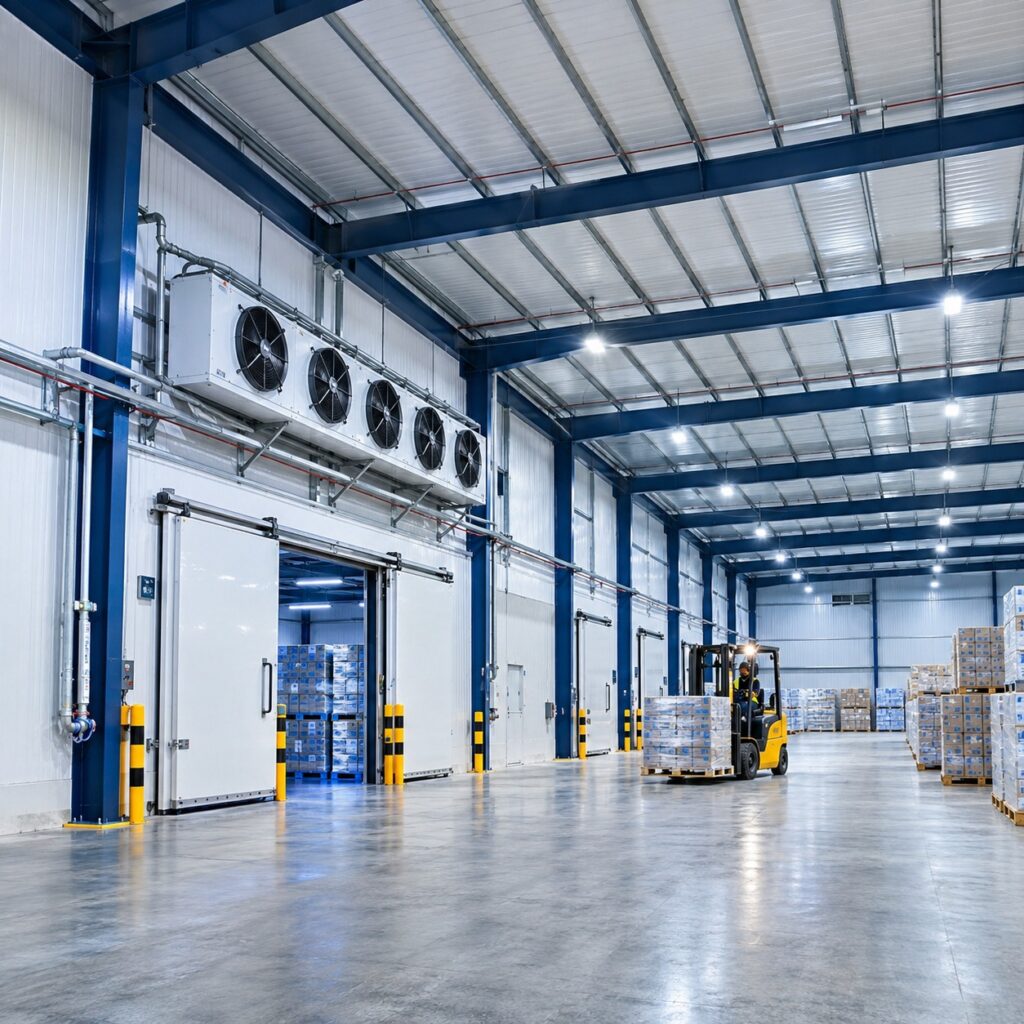
If condensation is not controlled, water droplets can form roof sheets, structural members, insulation surfaces, doors, and other components. Over time, repeated moisture exposure can contribute to corrosion, insulation deterioration, and other building maintenance concerns. In food and pharmaceutical storage facilities, condensation can also create operational problems. Moisture around working areas, entrances, or stored-product zones can affect hygiene, floor conditions, and the overall environment of the facility.
How Temperature Differences Create Condensation
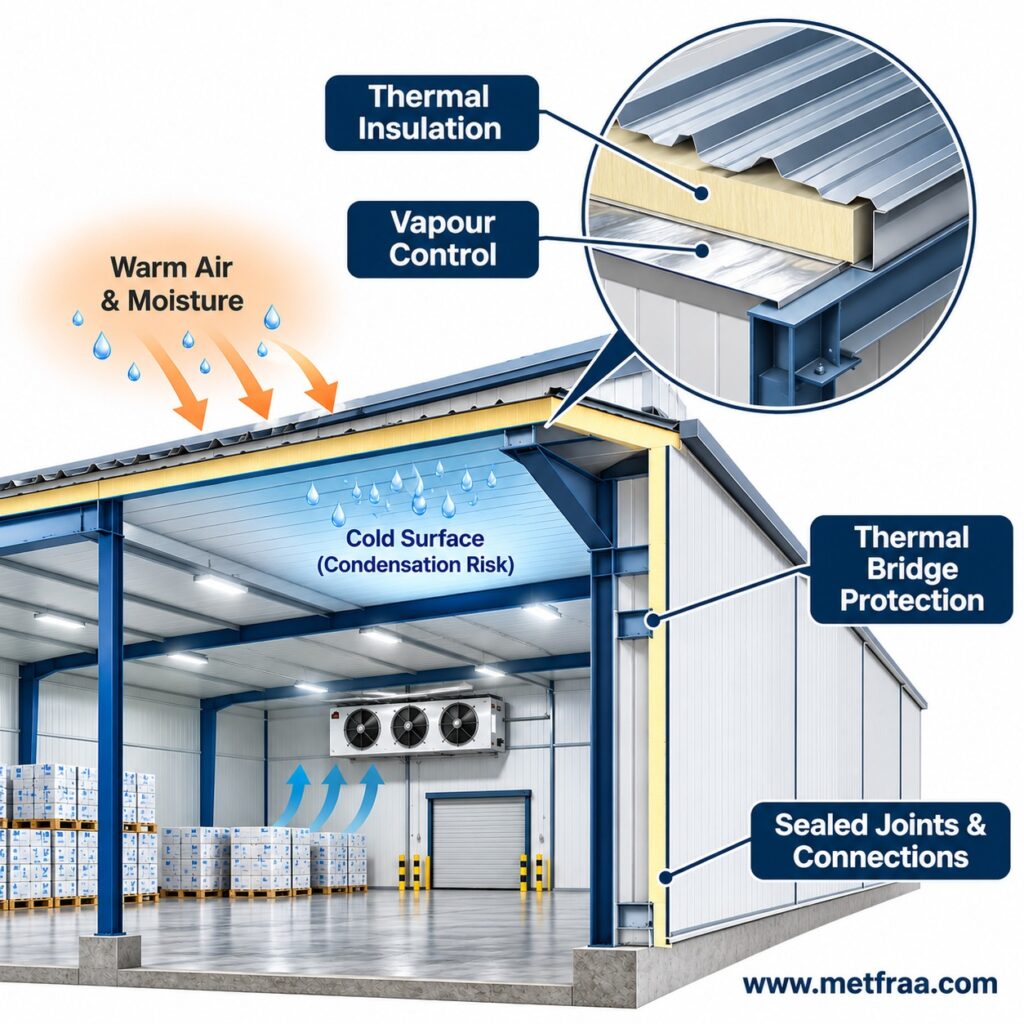
The basic cause of condensation is the interaction between temperature and moisture. When warm air containing moisture reaches a sufficiently cold surface, the moisture can change from vapor into liquid water.
In a cold storage building, this can happen around areas where there are temperature differences between internal and external environments. Roof assemblies, wall panels, doors, joints, and penetrations can become vulnerable if they are not properly detailed.
The greater the temperature difference, the more important it becomes to control the movement of warm, humid air into cold zones. This is a key consideration when planning a steel building that must maintain stable internal temperatures. Building design therefore needs to consider both thermal performance and moisture movement.
The Role of the Building Envelope
The building envelope acts as a barrier between the controlled internal environment and external conditions. In a cold storage facility, its performance has a direct relationship with temperature stability and condensation control.
Roofing, wall systems, insulation, joints, doors, and penetrations all contribute to the performance of the envelope. A weakness at any one location can allow air or moisture to move into areas where condensation may occur. In a steel building, continuity across roof and wall interfaces is therefore especially important.
A properly coordinated envelope helps maintain the required internal temperature while limiting uncontrolled moisture movement. This makes envelope design an important part of cold storage construction rather than simply a finishing consideration.
Why Insulation Is Important
Insulation helps reduce heat transfer between the cold interior and the warmer external environment. It also helps maintain the temperature of internal surfaces so that they are less likely to fall into conditions where condensation can occur.
The required insulation system depends on the facility’s temperature range, building configuration, and operational requirements. The insulation specification for a steel building should reflect the actual storage conditions and operating cycle. Insulation thickness, continuity, and installation quality all influence its performance.
Gaps, damaged insulation, or poorly sealed joints can create localized cold spots. These areas may become more vulnerable to condensation even when the overall insulation system appears adequate.
Vapour Control and Moisture Movement
Insulation alone cannot prevent every condensation problem. Moisture movement through the building envelope also needs to be controlled.
A vapor-control layer can help restrict moisture from migrating into parts of the building assembly where it may condense. Its location and continuity should be considered according to the temperature conditions and construction system being used.
Joints, penetrations, and connections require particular attention because even small discontinuities can become pathways for moisture movement. These details should be resolved during steel building design rather than left until installation. Proper detailing helps maintain continuity across the building envelope.
Roof Design and Condensation Control
The roof is one of the most important areas to consider because it covers a large surface area and can experience significant temperature differences between its internal and external sides.
Roof sheets, insulation, vapor-control layers, fasteners, and supporting members need to work together as a complete system. Poorly sealed joints or discontinuities can create locations where moisture enters or where cold surfaces become exposed.
The external roofing layer also needs to be selected according to the building’s weather protection and durability requirements. Explore metal roofing sheets for industrial buildings from Crayon Roofings.
Roof design should therefore consider thermal performance, drainage, weather protection, and condensation control together. For a steel building, the roof assembly should be assessed as a complete system, including its supporting members and interfaces. Regular inspection and maintenance are also important for identifying damaged or deteriorated components.
Managing Thermal Bridges
A thermal bridge occurs when heat moves more easily through a localized part of the building envelope than through the surrounding insulated area. Structural members, fasteners, joints, and penetrations can sometimes create these pathways.
In cold storage facilities, thermal bridges can result in localized temperature differences on internal surfaces. If those surfaces fall below the dew point, condensation may develop.
Reducing unnecessary thermal bridging and properly detailing structural connections can improve the continuity of the building envelope. This helps a steel building maintain more consistent internal surface temperatures. This becomes particularly important around areas where structural components pass through insulated assemblies.
Door Openings and Air Infiltration
Cold storage doors are frequently opened during loading and unloading operations. Every opening allows warmer and potentially more humid air to enter the controlled environment.
If air infiltration is not managed, moisture can enter the facility and condensed on colder surfaces. This can become particularly noticeable around door frames, ceilings, floors, and nearby structural components.
Door design, sealing, operating procedures, and traffic management can therefore contribute to condensation control. These measures are important to the performance of a steel building with frequent loading activity. High-traffic areas may require additional consideration because repeated door opening can increase the moisture load inside the facility.
Joints, Penetrations and Connection Details
Large cold storage facilities contain numerous service penetrations for electrical systems, refrigeration equipment, drainage, fire protection, and other utilities. Each penetration creates a potential location where the envelope can be interrupted.
If these areas are not properly sealed, warm air and moisture can enter the insulated assembly. Over time, this can contribute to condensation and reduce the effectiveness of the thermal envelope.
Detailed planning of joints and penetrations helps maintain insulation and vapor-control continuity. In a steel building, careful coordination of service openings can reduce weak points in the envelope. These small construction details can have a significant effect on the long-term performance of the building.
Condensation and Structural Steel
Structural steel itself is not the cause of condensation, but steel members can become cold surfaces when they are exposed to temperature differences. If warm, humid air reaches these surfaces, moisture may form on them.
Selecting suitable structural sections is also important when planning industrial facilities. Explore MS beams and RS joists from Bharat Steel Chennai for industrial structural requirements.
Repeated exposure to moisture can increase the risk of corrosion, particularly where protective coatings are damaged or maintenance is neglected. This makes moisture control relevant to both the building envelope and the long-term protection of the structural system.
Proper detailing, suitable protective measures, and regular inspection can help reduce the risk of moisture-related deterioration. Structural steel should therefore be considered as part of the overall cold storage environment. The design of a steel building should also account for protecting exposed members from repeated moisture.
Ventilation and Humidity Management
Condensation control also depends on managing the internal environment. Temperature and humidity levels should be maintained according to the requirements of the stored products and facility operations.
Ventilation requirements vary between cold storage applications, and uncontrolled air movement can sometimes introduce additional moisture. The ventilation and refrigeration strategy should therefore be coordinated with the building envelope. This coordination supports the environmental performance expected from a steel building used for cold storage.
Monitoring temperature and humidity can also help identify changing conditions before condensation becomes a significant problem. This is particularly useful in large facilities where environmental conditions may vary between different operational zones.
Maintenance Plays an Important Role
Even a well-designed cold storage building requires regular inspection and maintenance. Roofing damage, deteriorated seals, damaged insulation, loose fasteners, or failed joints can gradually reduce the performance of the building envelope.
Early identification of these problems allows corrective action before moisture reaches more vulnerable components. Regular checks help preserve the long-term performance of the steel building and its envelope. Maintenance teams should pay particular attention to areas around doors, joints, penetrations, and roof connections.
A maintenance programmed should therefore consider both the structural system and the thermal envelope. Keeping these systems in good condition supports consistent performance over the facility’s operating life.
Planning for Large-Scale Cold Storage Operations
Large cold storage facilities may include multiple temperature zones, loading areas, staging spaces, and technical rooms. Each area can have different environmental requirements and therefore different condensation risks.
The structural and building-envelope design should be coordinated with the operational layout. Refrigeration equipment, service routes, loading areas and access points can all influence how the building responds to temperature and moisture conditions.
Planning these requirements at the early design stage can reduce the need for modifications later. This early coordination is particularly valuable for a steel building serving multiple temperature zones. It also provides an opportunity to identify areas that require additional insulation, sealing, or environmental control.
The overall building layout should also support the specific requirements of temperature-controlled storage. Explore our guide to PEB cold storage warehouse construction for more information on planning these facilities.
Metfraa Approach to Cold Storage Building Design
Metfraa Steel Buildings approaches industrial building projects by considering the structural system together with the functional requirements of the facility. For cold storage applications, factors such as building configuration, clear spans, roofing, insulation, service integration, access, and future requirements can be considered during project planning.
A coordinated approach helps ensure that the steel structure and building envelope work together rather than being treated as separate elements. This is particularly important for facilities where temperature control and moisture management are critical to daily operations.
Conclusion
Condensation control in a large cold storage facility starts with proper building design. Structural planning, insulation, vapor control, roofing, joints, doors, service penetrations, and environmental management all contribute to the performance of the facility.
A strong steel structure alone is not enough to maintain a reliable cold storage environment. The complete building envelope needs to be planned to control heat transfer and unwanted moisture movement while supporting the operational requirements of the facility.
With the right design and regular maintenance, cold storage buildings can provide a more stable internal environment while reducing moisture-related problems and protecting critical building components. Metfraa Steel Buildings can help businesses plan industrial steel structures around their specific operational and building requirements.
If you are planning a large cold storage warehouse, temperature-controlled facility or industrial steel building, contact Metfraa Steel Buildings to discuss your project.
Frequently Asked Questions
1. How can Metfraa Steel Buildings help with condensation control in cold storage facilities?
Metfraa Steel Buildings can plan industrial steel building solutions by considering structural requirements, building configuration, roofing, insulation, service integration, and the operational needs of the cold storage facility.
2. What is the main cause of condensation in cold storage buildings?
Condensation generally occurs when moisture-laden warm air meets surfaces that are below the air’s dew point. Temperature differences, air infiltration, and gaps in insulation or vapor control can increase the risk.
3. Can poor insulation increase condensation problems?
Yes. Gaps, discontinuities, or inadequate insulation can create colder surfaces within the building envelope. These areas may become more susceptible to condensation when exposed to moisture-laden air.
4. How can condensation be reduced around cold storage doors?
Effective door sealing, controlled opening practices, suitable door systems and managing air infiltration can help reduce the amount of warm, humid air entering the cold storage environment.