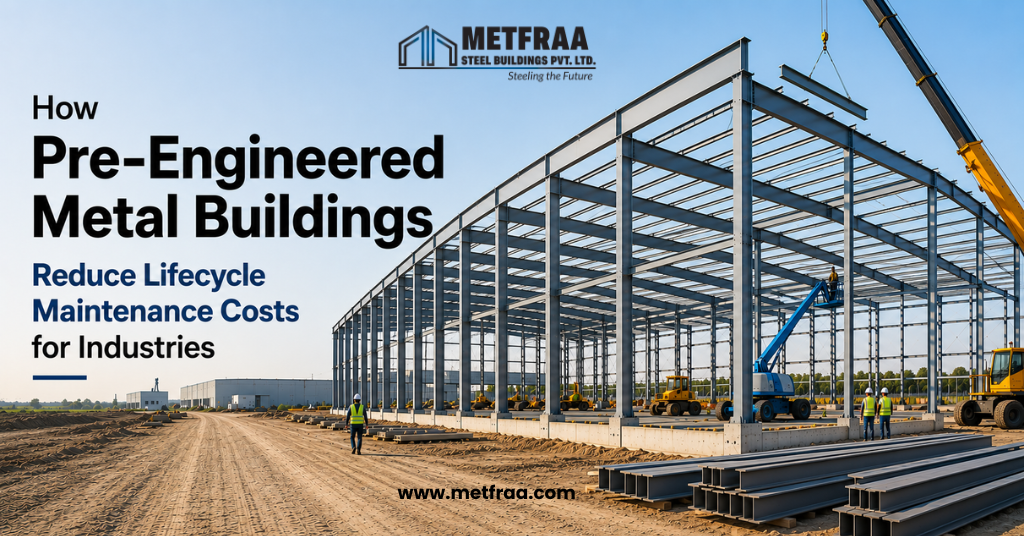
When making plans for industrial shed in the year 2026, factors like the durability of construction will be prioritized by organizations. There will be an emphasis on ensuring that the structures are durable, efficient, and effective throughout their operational lifetimes, as well as lowering the cost of maintenance.
This is why Pre-Engineered Metal Buildings have become increasingly common in modern industries. Unlike RCC structures, Pre-Engineered Metal Buildings are specifically designed to decrease any repetitive maintenance issues, while increasing reliability and efficiency.
In many cases, existing industrial structures require significant waterproofing, painting, repair, and roof maintenance services. On the other hand, PEMBs are constructed using perfectly engineered steel components and rust-resistant materials. Industries today also prefer ready-to-use structural steel solutions, which makes it easier to decrease the frequency of maintenance procedures and associated expenses
Why Do Industrial Buildings Have High Maintenance Costs?
Industrial building is subjected to continuous environmental and operational stress due to factors such as moisture, temperature variations, vibrations caused by heavy machinery, leaks in the roof, and rusting, which degrade the building’s performance and increase its maintenance cost.
The common defects in conventional industrial buildings include:
- Roof leaks
- Cracks in structural members and rusting
- Degradation of paint
All these maintenance issues lead to increased operational expenses and reduced efficiency in the industry. This explains why industries are shifting towards low-maintenance industrial steel buildings.
How Pre-Engineered Metal Buildings Reduce Industrial Maintenance Costs Over Time
Corrosion-Resistant Steel Improves Building Durability
Corrosion is one of the leading causes of deterioration in industrial structures. The Modern Pre-Engineered Metal Building uses galvanized steel and heavy-duty protective coating to withstand rusting and weathering.
This reduces your repainting needs, structure repairs, or any maintenance associated with corrosion. Industries located near the coast or in humid environments benefit immensely from the corrosion-resistant properties of steel.
According to the World Steel Association, modern steel continues to play a critical role in durable industrial infrastructure worldwide.
Precision Engineering Reduces Structural Wear and Tear
Construction methods have, at times, resulted in structural inconsistencies and poor load distribution. This has proven to be the opposite of what happens during the creation of Pre-Engineered Metal Buildings. This is due to the advanced engineering technology used in the design process.
Such engineering precision leads to decreased risk factors such as stress concentration and structural deformities. In turn, industries are subject to lower repair costs. The structural accuracy reduces the need for maintenance, thus saving the industries money.
Another advantage of steel construction is increased consistency since all parts are made under controlled factory conditions as opposed to on-site construction.
Roofing Systems in Peb Metal Buildings Minimize Leakage Issues
Roof leaks continue to be the costliest industrial maintenance issue. It causes interior destruction and damages the machinery, insulation, and operational areas inside the structure.
However, modern industrial roofing systems that include Pre-Engineered Metal Buildings are specifically designed with advanced sealing technology, sloping systems, and top-grade fasteners that prevent water leaks.
The use of such systems results in decreased need for waterproofing and lowers maintenance costs. In contrast, industries that utilize old roofing systems have high repair costs since these roofs fail repeatedly.
Pest, Termite, and Mold Resistance Reduce Maintenance Costs
Unlike other conventional building materials, steel prevents infestation by termites and pests. There is no cost associated with termite treatments, replacements, and repairs that come with such infestation issues.
Additionally, steel structures are effective in moisture control. Therefore, mold is prevented from forming within the premises, thus being ideal for industries that require a hygienic environment, especially food processing and pharmaceuticals.
Energy-Efficient Design Lowers Operational Costs
Modern industrial buildings require energy efficiency without compromising their durability.
This helps the industry minimize heating or cooling needs, thereby reducing energy expenses.
Are Pre-Engineered Metal Buildings Better Than RCC Structures?
Pre-Engineered metal structures offer various significant advantages over standard RCC structures in many industrial applications.
Advantages that can be seen in PEB designs include:
- Shorter construction times
- Lesser maintenance needs
- Ease of further development
- Greater economy throughout the life cycle
Industries such as warehousing, logistics, manufacturing, automotive, and food processing increasingly prefer steel building systems because of their scalability and operational benefits.
Industries That Benefit Most from Pre-Engineered Metal Buildings
The manufacturing sector requires metal buildings because they can bear heavy equipment and have minimal maintenance costs due to their ability to operate efficiently. For the logistics industry, PEB buildings are suitable due to their spacious interior area, quick construction process, and easy maintenance of roofs.
Other industries benefiting from steel buildings include food processing and pharmaceutical industry due to its ability to ensure hygienic conditions by minimizing moisture. Finally, the heavy engineering sector requires strong steel buildings that can withstand various forces such as crane lifting systems and vibrations, therefore making PEB buildings suitable.
What Makes Pre-Engineered Metal Buildings More Durable?
There are several engineering factors that contribute to the durability of such buildings including:
- Use of high-tensile structural steel
- Use of corrosion-resistance finishes
- Precise fabrication process
- Engineering roofing systems
PEB buildings are prefabricated using controlled environments, hence more reliable compared to many other conventional construction methods.
Long-Term ROI of Pre-Engineered Metal Buildings
Among the biggest strengths of steel building systems is their capacity to lower operating expenditures on a sustained basis.
Industries can significantly reduce costs related to:
- Maintenance of structures
- Waterproofing and painting
- Roof maintenance
- Rodent control services
In addition, low maintenance steel infrastructures minimize operational interruptions related to routine maintenance activities. This results in increased productivity of industrial operations.
Another strength of pre-engineered metal buildings is their scalability. Industrial organizations will be able to increase the size of factories easily through extensions and additions.
Key Factors That Influence Maintenance Performance in PEB Buildings
Not every steel building system offers the same level of maintenance performance. Materials, roofing designs, manufacturing quality, and engineering standards have a great impact on the effectiveness of maintenance operations.
Companies need to consider the engineering and experience of their pre-engineered metal building manufacturer before investing.
Experienced Peb Manufacturers such as Metfraa Steel Buildings are dedicated to offering industrial steel building systems that are scalable, robust, and maintenance friendly.
Conclusion:
Infrastructure planning for industry in the year 2026 emphasizes efficiency in operation over time and not just the initial cost. Pre-engineered metal buildings minimize maintenance costs using corrosion-resistant steel, accurate design, engineered roof, and energy-efficient construction.
In comparison to traditional buildings, industrial steel buildings provide more durability, ease of maintenance, scalability, and profitability. Industrial sectors such as warehousing, manufacturing, logistics, food processing, and heavy engineering are increasingly considering PEB in their future infrastructure planning.
For a durable, scalable, and maintenance-free infrastructure, the selection of the appropriate PEB provider is essential. Contact Metfraa Steel Buildings to provide engineered steel construction for efficient performance and growth.
Frequently Asked Questions (FAQs):
Q. What are Pre-Engineered Metal Buildings?
A. Pre-Engineered Metal Buildings are steel structures designed and manufactured in factories for faster construction and lower maintenance.
Q. How do Pre-Engineered Metal Buildings reduce maintenance costs?
A. They reduce maintenance costs by preventing corrosion, minimizing roof leakage, and lowering repair requirements over time.
Q. Are Pre-Engineered Metal Buildings better than RCC structures?
A. For many industries, yes. They offer faster construction, easier expansion, and lower long-term maintenance costs.
Q. Why are steel industrial buildings easier to maintain?
A. Steel buildings resist termites, moisture, mold, and corrosion better than many traditional construction materials.
Q. Are Pre-Engineered Metal Buildings suitable for warehouses?
A. Yes. They are ideal for warehouses because they provide large open spaces, faster installation, and lower maintenance requirements.