Chennai has emerged as one of India’s leading manufacturing destinations, supported by thriving automotive, electronics, engineering, aerospace, pharmaceutical, and logistics industries. As industrial activity continues to expand, manufacturers are under constant pressure to increase production capacity while controlling operational costs. However, one major challenge continues to affect factory expansion across the region with limited industrial land availability.
Established industrial corridors such as Oragadam, Sriperumbudur, Ambattur, Maraimalai Nagar, and Gummidipoondi have witnessed a sharp rise in industrial land prices over the past decade. In many cases, neighboring plots are either unavailable or prohibitively expensive, making horizontal expansion difficult for growing businesses.
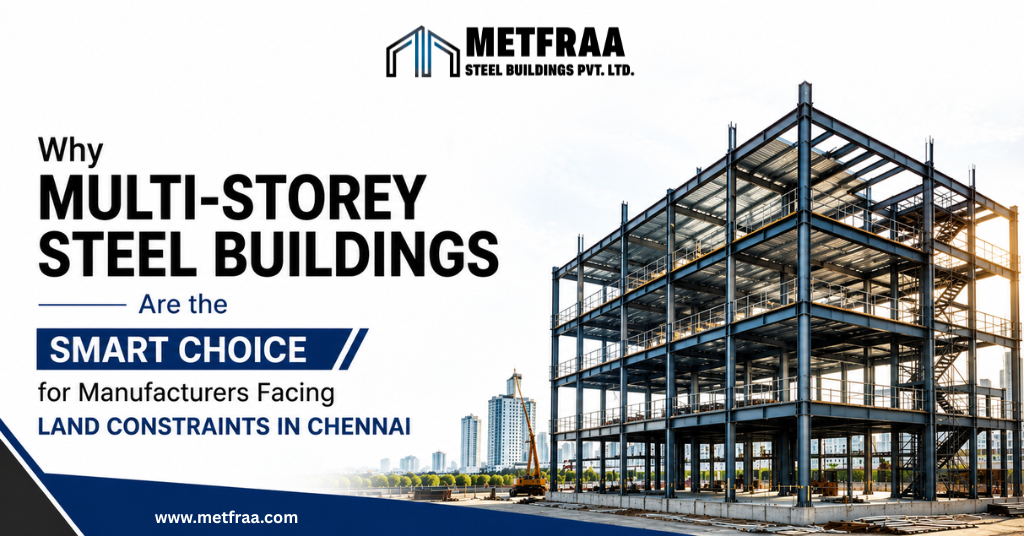
Rather than relocating facilities or investing heavily in additional land, many manufacturers are now adopting Multi-Storey Steel Buildings in Chennai to maximize their existing property. By expanding vertically, businesses can add production floors, warehousing, offices, laboratories, and utility spaces within the same footprint while minimizing operational disruption
Why Manufacturers in Chennai Face Land Constraints
The demand for industrial infrastructure across Chennai continues to grow as businesses expand their manufacturing capabilities. However, acquiring additional industrial land has become increasingly difficult due to several market and operational factors.
Rising Industrial Land Costs
Industrial zones around Chennai remain highly attractive because of their excellent connectivity to ports, national highways, airports, and supplier ecosystems. As demand continues to increase, land prices have risen considerably, making horizontal expansion a significant capital investment. For many businesses, investing in Multi-Storey Steel Buildings Chennai provides a more cost-effective long-term strategy than purchasing new land.
Limited Availability of Large Industrial Plots
Many established manufacturing facilities are located within fully developed industrial estates where adjoining land is either unavailable or fragmented across multiple owners. Even when land becomes available, obtaining contiguous plots suitable for expansion can delay projects and increase acquisition costs.
Growing Production Requirements
Manufacturers across automotive, engineering, electronics, and pharmaceutical sectors are scaling operations to meet domestic demand and export opportunities. Instead of relocating production facilities, businesses are increasingly adopting vertical industrial expansion to add production lines, warehousing, laboratories, employee amenities, and office spaces within their existing premises.
Better Utilization of Industrial Land
Industrial land is a valuable business asset. Expanding vertically enables manufacturers to maximize every square meter while maintaining existing logistics networks, utility connections, and workforce accessibility. This approach improves return on investment and supports long-term manufacturing growth.
Benefits of Multi-Storey Steel Buildings for Manufacturers
1. Maximizes Industrial Land Utilization
The most significant advantage of industrial steel structures in Chennai is their ability to create additional operational space without increasing land requirements. Manufacturers can substantially increase their built-up area while continuing to operate from their existing site.
2. Supports Manufacturing Facility Expansion
Additional floors can accommodate production lines, assembly units, warehousing, quality control laboratories, maintenance workshops, administrative offices, research facilities, or employee amenities. This enables businesses to scale operations efficiently while maintaining organized workflows.
3. Faster Construction with Minimal Business Disruption
Unlike conventional RCC construction, structural steel components are fabricated off-site while foundation work progresses simultaneously. Once delivered, erection can begin immediately, reducing overall project timelines. Faster construction enables manufacturers to commission new facilities sooner and minimizes production interruptions.
4. Lower Structural Weight and Efficient Foundation Design
Steel offers an excellent strength-to-weight ratio, resulting in lower dead loads than conventional concrete structures. Depending on site-specific soil conditions, this may reduce foundation requirements and improve seismic performance. Structural engineers optimize column spacing, beam sizing, and load distribution to deliver safe and efficient industrial building construction.
5. Flexible Future Expansion
Business requirements evolve over time. Properly engineered structural steel buildings can often accommodate additional floors or horizontal extensions with greater ease than conventional RCC structures. Planning for future expansion during the initial design stage helps manufacturers avoid costly modifications while supporting long-term business growth.
6. Improves Operational Workflow and Material Handling
A well-planned multi-level factory building does more than add floor space; it improves the efficiency of daily manufacturing operations. By strategically allocating functions across different levels, manufacturers can streamline production, reduce material handling time, and create safer working environments.
For example, raw material storage can be located on the ground floor, production and assembly lines on intermediate floors, while quality inspection, packaging, and administrative offices occupy the upper levels. This logical workflow minimizes unnecessary movement of materials and personnel, resulting in improved productivity.
Modern industrial steel structures in Chennai can also integrate goods of lifts, freight elevators, conveyors, overhead cranes, and automated material handling systems. These features support lean manufacturing practices by improving internal logistics and reducing operational bottlenecks.
7. Supports Sustainable Industrial Development
Sustainability has become an important consideration in industrial construction. Structural steel is one of the most recyclable construction materials available, making it an environmentally responsible choice for manufacturing facilities.
Compared to conventional construction, steel fabrication generates less on-site waste because most components are manufactured under controlled factory conditions. Additionally, modern steel factory buildings can easily incorporate energy-efficient roofing systems, natural daylighting, ventilation, rainwater harvesting, rooftop solar panels, and insulated wall systems to reduce operational energy consumption.
For manufacturers pursuing sustainable growth, multi-storey steel buildings contribute to both environmental performance and long-term operational efficiency.
What Are Multi-Storey Steel Buildings?
Multi-storey steel buildings are engineered with industrial facilities designed to support manufacturing operations across multiple floors using structural steel framing systems. The primary structural components include steel columns, primary and secondary beams, composite floor systems, bracing members, and high-strength bolted connections that work together to provide exceptional load-bearing capacity and structural stability.
Unlike conventional reinforced concrete (RCC) buildings, most steel components are precision-fabricated in manufacturing facilities before being transported to the project site for assembly. This off-site fabrication improves dimensional accuracy, reduces construction waste, and significantly shortens project schedules.
Many PEB multi-storey buildings also follow modular engineering principles, making future expansion easier without extensive structural modifications. Their high strength-to-weight ratio allows for larger column-free spaces, improved equipment layout, and greater flexibility for changing manufacturing requirements.
Industries That Benefit the Most
Although almost any manufacturing facility can benefit from vertical expansion, certain industries gain the greatest advantage from Multi-Storey Steel Buildings in Chennai because of their space-intensive operations.
Automotive and Auto Component Manufacturing
Additional floors provide space for machining, assembly, testing, inventory storage, and administrative operations while maintaining efficient production flow.
Engineering and Heavy Fabrication
Engineering companies can accommodate fabrication units, CNC machinery, tool rooms, maintenance areas, and finished goods storage within a single integrated facility.
Electronics Manufacturing
Electronics manufacturers benefit from organized production layouts, clean assembly environments, testing laboratories, and controlled storage areas.
Textile and Garment Industries
Multi-level layouts allow manufacturers to separate cutting, stitching, embroidery, finishing, quality inspection, packing, and warehousing, and improving production efficiency.
Food Processing and Pharmaceuticals
These industries require well-defined operational zones to meet hygiene and regulatory standards. Multi-storey facilities help create dedicated processing, packaging, storage, and laboratory spaces while supporting compliance requirements.
Warehousing and Logistics
Distribution centres can significantly increase storage capacity by utilizing vertical space instead of expanding across additional land, improving inventory management, and dispatch operations.
Multi-Storey Steel Buildings vs Conventional RCC Buildings
Choosing the right structural system is one of the most important decisions during an industrial expansion project. The following comparison highlights the key differences.
| Feature | Multi-Storey Steel Buildings | Conventional RCC Buildings |
| Construction Speed | Faster through off-site fabrication | Longer due to on-site casting and curing |
| Structural Weight | Lightweight with excellent strength-to-weight ratio | Heavier structural system |
| Foundation Requirements | Lower dead load may reduce foundation size | Higher structural load generally requires larger foundations |
| Expansion Flexibility | Easier to modify and expand | Future modifications are comparatively difficult |
| Construction Accuracy | Precision factory fabrication | Greater dependence on site workmanship |
| Maintenance | Easier inspection and component replacement | Repairs may require extensive civil work |
| Sustainability | Recyclable steel with lower construction waste | Higher material consumption and demolition waste |
| Project Downtime | Reduced installation time minimizes operational disruption | Longer construction can impact business operations |
Common Mistakes to Avoid
Manufacturers can significantly improve project outcomes by avoiding these common mistakes:
- Purchasing land before evaluating vertical expansion opportunities.
- Underestimating machinery and floor loading requirements.
- Ignoring future production growth during structural design.
- Selecting unsuitable structural systems based only on initial construction costs.
- Overlooking fire safety planning and statutory compliance.
- Failing to optimize production workflow and material handling.
Early collaboration between architects, structural engineers, and industrial construction specialists reduces project risks and improves long-term operational efficiency.
Why Work with Experienced Industrial Steel Building Specialists?
Designing a multi-storey steel building involves much more than erecting a structural frame. Every project requires careful coordination between architectural planning, structural engineering, utility integration, workflow optimization, safety compliance, and future expansion planning.
With extensive experience in industrial construction, Metfraa Steel Buildings Pvt. Ltd. helps manufacturers across Chennai develop efficient steel building solutions tailored to their operational requirements. From Pre-Engineered Buildings (PEB) and Structural Steel Buildings to Industrial Sheds, Structural Restoration, and Re-Roofing Services, the company supports businesses in developing modern industrial infrastructure that delivers long-term value.
As industrial land becomes increasingly scarce and expensive, manufacturers need smarter expansion strategies that support long-term growth without disrupting ongoing operations. Multi-Storey Steel Buildings in Chennai offer a practical solution by maximizing available land, accelerating construction, improving operational efficiency, and providing the flexibility to adapt to future business requirements.
Whether you are planning a new manufacturing facility or expanding an existing one, careful engineering, structural planning, and workflow optimization are critical to project success. Contact Metfraa Steel Buildings they can help you evaluate the most suitable expansion strategy, optimize structural performance, and develop a future-ready facility that supports sustainable business growth for years to come.
Frequently Asked Questions
Q. Are multi-storey steel buildings suitable for heavy manufacturing industries?
Yes. They can be engineered to support heavy machinery, overhead cranes, high floor loads, and specialized manufacturing equipment based on project-specific structural calculations.
Q. Is constructing a multi-storey steel building more economical than purchasing additional industrial land?
In many situations, yes. Vertical expansion allows manufacturers to maximize their existing property, often making it a more cost-effective solution than acquiring additional industrial land in high-demand locations.
Q. How long does it take to construct a multi-storey steel building?
Project duration varies depending on building size, approvals, and complexity. However, steel structures are generally completed much faster than conventional RCC buildings because major components are fabricated off-site.
Q. Which industries benefit the most from multi-storey steel buildings?
Automotive, engineering, electronics, pharmaceuticals, food processing, textiles, warehousing, logistics, and precision manufacturing industries commonly benefit from vertical industrial expansion.
Q. Can an existing factory be expanded into a multi-storey steel building?
Yes. Subject to structural evaluation and site conditions, many existing industrial facilities can be upgraded or expanded using steel construction techniques.
Q. Are multi-storey steel buildings earthquake-resistant?
When designed in accordance with relevant Indian Standards and seismic design requirements, steel buildings offer excellent structural performance due to their strength, ductility, and lighter structural weight.