Re-roofing an active factory without shutting down operations is no longer a complex challenge it is a practical and strategic solution in today’s industrial environment. In a landscape where continuous production is critical, even minor disruptions can lead to financial losses, delayed timelines, and reduced operational efficiency. Manufacturing facilities operate on tightly aligned workflows, making downtime a costly decision for any business.
Traditionally, roof replacement was a process that demanded a complete halt in business activities. This, in turn, affected business productivity. However, with contemporary construction practices and execution strategies, this concept has changed. Now, it is possible to replace roofs seamlessly with a facility fully in operation.
This blog aims to discuss how this process occurs in real-world scenarios, with reference to the strategies, technologies, and practices that allow businesses to upgrade their infrastructure without affecting productivity.
What Is Re-Roofing an Active Factory Without Shutdown?
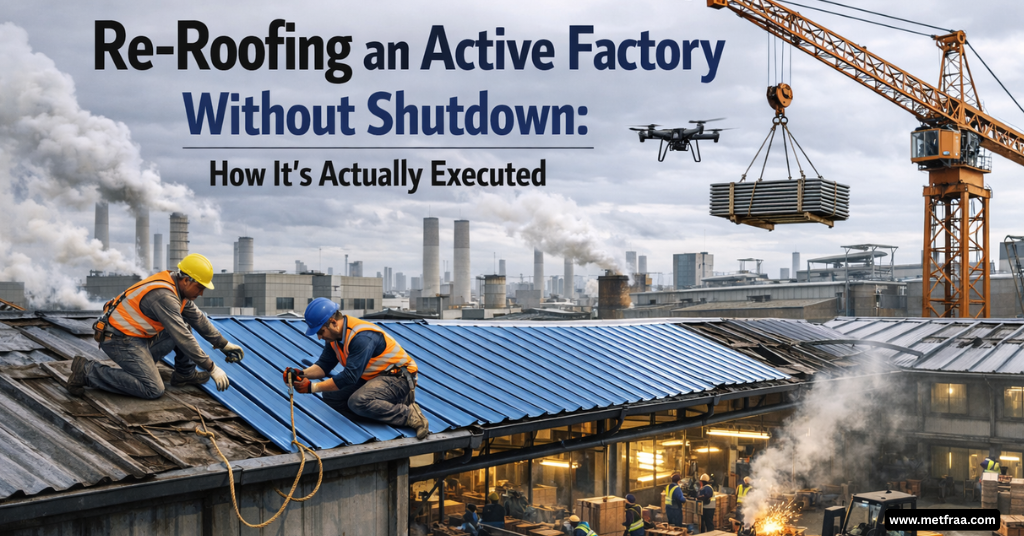
Re-roofing an active factory without shutting down is normally done in phases. In this method, different parts of an industrial roof are re-roofed while production is still ongoing. Temporary protection systems, advanced roofing materials, and proper planning are used to ensure that a factory is re-roofed without shutting down.
Why Re-Roofing Without Shutdown Is Critical for Industrial Facilities
In today’s manufacturing world, shutting down is not an option. Whether a factory is producing textiles, logistics, or heavy manufacturing, shutting down for a few hours means losing a lot of money.
This is precisely why most facility managers are opting for re-roofing without shutting down. for facility managers seeking to avoid downtime during roof replacement.
Key benefits include:
Some of the important advantages of Re-Roofing an Active Factory Without Shutdown’ are as follows:
- The production process is not interrupted.
- No disruption in the supply chain.
- The facility is not closed.
- The production process is not hampered.
Therefore, industrial roof replacement without shutdown is now an important roofing practice in many industries.
Industrial Re-Roofing Planning: The Foundation of Zero Downtime
A well-executed project actually commences long before any physical work is done. Planning is essential for safety, efficiency, and disruption-free execution.
Site Inspection and Structural Evaluation
The contractors examine:
- The condition of the roof and structural soundness
- Problematic areas that may lead to leaks or weak spots
- Ability to withstand weight load
This step is critical in coordinating roofing jobs with factory maintenance schedules.
Risk Management and Safety Program
A detailed safety program includes:
- Identification of hazards (fall hazards, debris, fire hazards, etc.)
- Worker safety
- Equipment and inventory protection
Planning will be necessary to reduce production downtime during roof installation.
Coordinating the Job With Factory Schedule
Roof installations are scheduled based on
- Periods of low production activity
- Off-peak working hours
- Maintenance shut-down time (where applicable)
Step-by-Step Industrial Re-Roofing Process Without Shutdown
To carry out re-roofing without shutting down a factory, a well-planned, step-by-step approach is needed.
1. Phased Roofing Plan (Sectional Installation)
The roof is segmented into smaller sections to enable gradual removal.
Advantages:
- Protects from elements
- Safety during construction
- Enables live roofing
2. Protective Systems
Prior to the removal of any section of the roof, temporary protection systems are set up, including.
- Waterproof tarps
- Temporary roofing materials
- Containment systems
- They ensure machinery and personnel safety.
3. Removal of Existing Roofing Materials
- The old roofing material is removed cautiously to:
- Ensure there is no dust spread
- Prevent fall of debris to production lines
- Keep the workspace tidy
- It is an important aspect of operational facility refurbishing.
4. Immediate Roofing Installation
Once the existing roofing material is stripped away, it must be replaced promptly to avoid exposing it to the elements. Examples of common industrial roofs are:
- Examples of common industrial roofs include:
- Metal roofs
- Roofs with TPO and EPDM membrane
- Roofs made of insulated panels
- Implementing quicker methods of installation is critical for minimizing downtime.
5. Continuous Inspection and Quality Control
- The entire process involves monitoring:
- The quality of installation
- Structural stability
- Safety regulations
- This guarantees consistency at all times.
Technologies Enabling Zero-Downtime Re-Roofing
The following are some of the modern innovations that make the whole process easier to execute:
1. Customized Roof Components
These materials have been pre cut and engineered, including structural supports like purlins, which ensure faster installation and better alignment during live roofing execution.
2. Modern Waterproofing Membranes
These membranes offer effective sealing and therefore there is minimal possibility of leakage when installing the roof.
3. Safety Gear
This includes safety clothing and even real-time monitoring tools to ensure that the safety of the workers is guaranteed.
4. Noise and Dust Prevention Devices
These gadgets are used to keep the level of dust and noise in the factory at a reasonable level.
Possible Challenges and the Way to Solve Them
Some of the difficulties involved in this project and their solutions include:
Operational interference
- How to overcome this challenge: By scheduling and zoning.
- Safety hazard
- How to overcome: By observing all safety measures.
- Bad weather
- Solve: Be flexible and put in place proper temporary protective measures.
- Coordination difficulties
- Solution: Through effective project management.
Re roofing an active factory without shutdown has evolved into a highly efficient and strategic solution for modern industries. With the right planning, advanced technologies, and phased execution approach, businesses can upgrade their roofing systems without compromising productivity or operational continuity. What was once considered a disruptive process is now a well structured method that supports both infrastructure improvement and business performance.
For organizations planning a reroofing project, partnering with the right experts makes all the difference. Explore how Metfraa Steel Buildings can support your facility with reliable, zero downtime roofing solutions by visiting our contact page and connecting with our team.
Frequently Asked Questions ( FAQ):
1. What is re-roofing an active factory without shutting down?
It’s replacing a factory roof in phases while production continues using temporary protection systems and careful scheduling.
2. Why is re-roofing without shutdown important?
It prevents costly downtime, protects revenue, and ensures continuous production during roof replacement.
3. How is it executed?
Contractors remove and replace roof sections one at a time, using temporary covers, debris control, and fast-install materials.
4. What technologies are used?
Prefabricated panels, TPO/EPDM membranes, safety monitoring, and dust/noise control systems streamline the process.