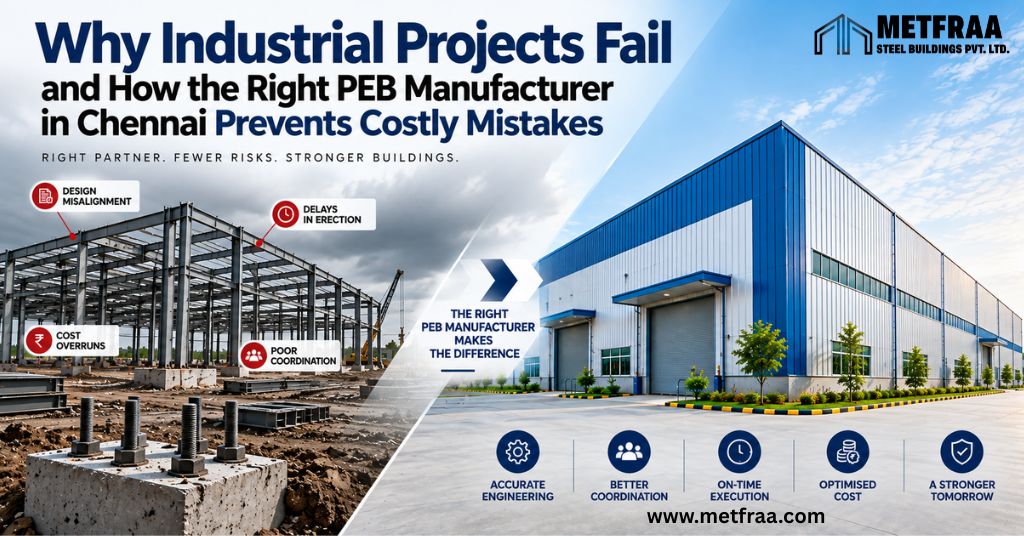
Choosing the right PEB manufacturer in Chennai can have a major impact on the cost, coordination and execution of an industrial project. An industrial project rarely becomes expensive because of one big mistake. More often, the cost starts with a decision that seemed small at the beginning.
Once the team erects the building, correcting that decision becomes considerably more difficult.The crane requirement came later. The design team prepared the foundation without complete structural information. The project team selected the roofing system mainly on price.
By the time these issues become visible at the site, correcting them is no longer simple.
Steel may already be fabricated. Foundations may already be cast. Materials may already be delivered. Other contractors may already be working around the structure.
This is why the choice of a PEB manufacturer in Chennai can directly influence the risk, cost and execution of an industrial project.
The right manufacturer does not simply manufacture what is shown on a drawing. The manufacturer should identify the decisions that can create problems later and address them before they become expensive.
How a PEB Manufacturer in Chennai Can Prevent These Mistakes
Industrial projects can fail in different ways.
Sometimes the project exceeds its budget.
In other cases, the completion date keeps moving.
The building may even be completed before the business realises that modifications are required.
And sometimes the structure itself is not the problem the building simply does not support the way the factory needs to operate.
The common factor is usually a gap between what the business needs and what was finally engineered and constructed.
That gap can develop during planning, design, procurement, fabrication or erection.
A good PEB partner has an opportunity to close that gap before it reaches the next stage.
Mistake 1: Designing the Building Before Understanding the Factory
A factory is designed for production.
That means the building must accommodate machinery, people, raw materials, finished products, cranes, vehicles, storage and maintenance activities.
If the structural design begins with only length, width and height, important operational requirements can easily be missed.
For example, a production machine may require more clearance than expected. A forklift route may need an unobstructed bay. Similarly, large equipment may require a wider opening for entry.
These are not minor architectural changes.
They can influence the structural arrangement.
A capable PEB manufacturer in Chennai should therefore understand the factory’s operating requirements before the structural design is frozen.
How to Design Around Factory Requirements
The manufacturer should review the machinery layout, internal movement, clear heights, openings, crane requirements and other operational constraints during the engineering stage.
The objective is simple:
Design the building around the operation not the operation around the building.
Mistake 2: Treating Crane Requirements as an Addition
In many manufacturing facilities, overhead cranes are essential.
Yet crane requirements are sometimes introduced after the main building design has already been developed.
That can create serious complications.
Crane loads, runway requirements, lifting height and operating clearances can influence the structural system.
If these requirements are considered too late, structural modifications may become necessary.
How to Plan for Crane Requirements
Crane requirements should be identified before the structure is finalised.
The manufacturer can then consider the relevant loads, clearances and structural requirements as part of the engineering process.
This is one of the reasons an experienced PEB manufacturer in Chennai should be involved early rather than being treated only as a fabrication vendor.
Mistake 3: Getting the Column Arrangement Wrong
Columns provide structural support, but their location can also affect factory operations.
A poorly positioned column can interfere with machinery, vehicle movement, material handling or storage.
Once the building has been erected, correcting that decision becomes considerably more difficult.
Optimising Column Arrangement
Column positions should be reviewed against the actual factory layout.
Clear-span requirements, bay spacing and internal movement should be considered together so that structural efficiency does not come at the expense of operational efficiency.
Mistake 4: Ignoring Future Expansion
A factory may be designed for today’s production requirement, but businesses rarely stay the same.
Production increases. New machinery arrives. Storage requirements grow. Additional bays may become necessary.
If the business can foresee expansion, the team should discuss it during the original design.
Planning for Future Expansion
The objective is not necessarily to construct future capacity today.
Instead, the manufacturer can understand where the business expects to grow and consider whether the initial structural arrangement can support that direction of expansion.
Early planning can make future modifications easier than trying to redesign an operating facility.
Mistake 5: Choosing the Lowest Quotation
Price is important in industrial procurement.
But comparing PEB quotations only by price, steel weight or price per square foot can hide major differences. Understanding Steel procurement decisions is equally important when evaluating the overall project cost.
Two manufacturers may quote for the same building size but offer different specifications. These differences may include structural steel, roofing systems, accessories, insulation and erection scope.
The lower quotation may therefore not represent the lower overall project cost.
Evaluating Value Beyond Price
A professional PEB manufacturer in Chennai should clearly explain:
- Structural specifications
- Roofing and wall systems
- Accessories included
- Erection scope
- Exclusions
- Design assumptions
- Responsibilities of each party
Mistake 6: Separating Civil and Structural Work
A PEB structure and its foundation must work together.
If structural information changes after civil work has progressed, foundation modifications or erection delays can follow.
Anchor locations, foundation dimensions and structural interfaces all need proper coordination. In addition, the roofing system should be coordinated with the steel framework. This helps avoid issues during installation.
Coordinating Civil and Structural Work
The structural and civil teams should coordinate foundation requirements before construction reaches a stage where changes become difficult.
Clear communication between the structural and civil teams can prevent a design issue from becoming expensive site rework.
Mistake 7: Finding Fabrication Errors at the Site
A fabrication problem discovered inside the manufacturing facility is easier to address.
The same problem discovered after transportation can affect erection, manpower, equipment and the project schedule.
That is why fabrication accuracy is directly connected to project performance.
Preventing Errors Before Fabrication
The fabrication team should check cutting, drilling, welding, assembly, dimensions and component identification against the approved engineering information.
The goal is not simply to manufacture steel.
It is to manufacture components that are ready for their intended place in the structure.
Mistake 8: Treating Erection as Someone Else’s Responsibility
PEB components are manufactured in one location and assembled at another.
That makes erection planning an important part of the project.
Site access, material sequence, storage, lifting arrangements and foundation readiness can all affect progress.
A manufacturer may produce technically correct components, but poor coordination can still create delays at the site.
Taking Responsibility for Erection
Therefore, engineering, fabrication, transportation and erection should be treated as connected stages.
A reliable PEB manufacturer in Chennai should understand how fabricated components will reach the site and how they will be assembled.
The objective is to make erection an execution process not a place where unresolved design problems are discovered.
How Metfraa Approaches the Problem
The manufacturer’s role becomes important when it extends beyond simply fabricating the steel frame.
Metfraa Steel Buildings works in Pre-Engineered Buildings and industrial steel structures, along with capabilities in roofing, civil works, conventional steel structures, structural restoration and re-roofing.
This is relevant because industrial projects do not all have the same requirement.
A new manufacturing plant may require a complete PEB solution.
A warehouse may need a structure designed around storage and material movement.
A production unit may require crane and machinery considerations.
An existing factory may need structural restoration or re-roofing instead of complete reconstruction.
The solution should therefore follow the actual condition and requirement of the facility.
Metfraa’s PEB Solutions
Different industrial buildings can require different structural configurations.
Depending on the application and building requirements, Metfraa provides solutions such as rigid-frame clear-span, rigid-frame multi-span and tapered-beam configurations.
The important point is not simply having multiple configurations.
It is selecting the structural approach that suits the building’s purpose, span requirements, internal operations and project conditions.
This is where the role of a PEB manufacturer in Chennai moves beyond fabrication and into project-specific engineering.
When the Existing Building Is the Problem
Not every industrial project starts with an empty plot.
Some businesses already have ageing factories, damaged roofing, structural deterioration or buildings that need modification.
In such situations, constructing an entirely new building may not always be the only option.
Metfraa also works in structural restoration and re-roofing, allowing existing industrial buildings to be considered as part of the solution.
The question may not always be:
“How do we build a new factory?”
Sometimes it is:
“How do we make the existing factory safer, more functional and suitable for its next stage?”
That decision should come after proper assessment of the existing structure.
The Real Cost of a PEB Mistake
A structural mistake does not always appear as a large steel cost.
The actual impact can include:
Redesign + re-fabrication + transportation + additional labour + equipment downtime + site delay + production delay.
That is why preventing one major mistake can be more valuable than saving a small amount on the initial quotation.
The right PEB manufacturer in Chennai should understand where these risks can originate and address them while they are still manageable.
Don’t Wait for the Site to Find the Problem
By the time a problem becomes visible at the site, several decisions may already be locked in.
The foundation may be complete.
Steel may be fabricated.
Materials may be delivered.
Contractors may already be working.
Production schedules may be affected.
The better approach is to ask the difficult questions earlier:
Will the machinery fit?
Can the crane operate as required?
Are the columns compatible with the production layout?
Does the foundation match the structural requirement?
Does the quotation cover the actual project scope?
Can future expansion be considered?
These questions belong in the planning and engineering stage.
Build the Right Structure, Not Just a Fast Structure
Industrial construction is ultimately about supporting a business.
A factory needs to accommodate production today while remaining practical as the business changes tomorrow.
That is why choosing a PEB manufacturer in Chennai should not be based only on fabrication capacity or the lowest quotation.
Look at how the manufacturer approaches the project before fabrication begins.
Does the team understand the operation?
Does it ask the right questions?
Does it coordinate engineering with execution?
Does it identify risks before they reach the site?
These are the factors that can make a real difference to the final project outcome.
Conclusion
The right PEB partner helps address these decisions when they are easiest to solve—before fabrication and site execution.
For businesses planning a new factory, warehouse, manufacturing unit or industrial expansion, Metfraa Steel Buildings can help evaluate the structural requirement and develop a suitable PEB solution around the project.
Instead of comparing quotations based only on price, discuss your actual requirement with the team.
A costly mistake is much easier to fix on a drawing than at the site.
If you are planning a new factory, warehouse or industrial facility, Contact Us Metfraa Steel Buildings and discuss your project requirements with our team before fabrication begins.
Frequently Asked Questions
How can Metfraa help with PEB projects?
Metfraa Steel Buildings provides PEB solutions along with structural engineering, fabrication, roofing, civil works, restoration and re-roofing services.
What does a PEB manufacturer in Chennai do?
A PEB manufacturer designs and fabricates steel building systems based on a project’s structural and operational requirements.
Why should a PEB manufacturer be involved early?
Early involvement helps identify machinery, crane, clear-height and structural requirements before fabrication, reducing costly changes later.
Can an existing industrial building be upgraded?
Depending on its condition, structural restoration, strengthening or re-roofing may be possible instead of complete replacement.