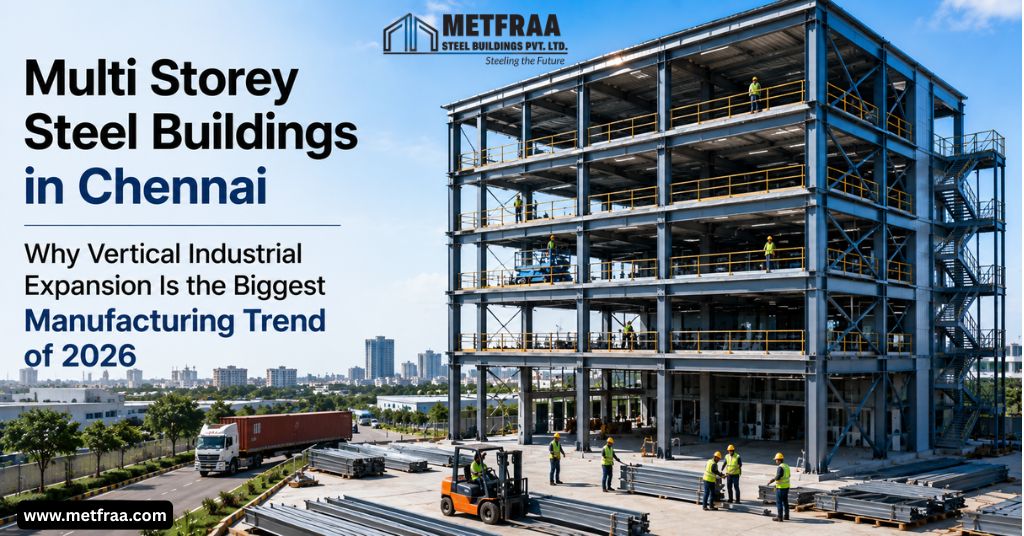
Multi Storey Steel Buildings in Chennai are rapidly becoming the preferred solution for manufacturers seeking expansion without acquiring additional land. As industrial land prices continue to rise and urban industrial zones become increasingly congested, companies are shifting their focus toward vertical expansion strategies that maximize available space while maintaining operational efficiency.
Across Chennai’s manufacturing corridors, industrial estates, and logistics hubs, businesses are investing in multi-storey steel structures to accommodate production lines, warehousing operations, automated systems, research facilities, and administrative functions within a single integrated facility. This trend is expected to accelerate throughout 2026 as manufacturers seek scalable, cost-effective, and future ready infrastructure solutions.
The growing adoption of multi-storey industrial buildings represents more than a construction trend it reflects a strategic shift in how industrial infrastructure is planned, designed, and optimized for long term growth.
Why Manufacturers Are Moving from Horizontal to Vertical Expansion
Traditional industrial development focused on horizontal growth. When additional capacity was required, companies simply acquired adjacent land and extended their facilities.
However, several market realities are challenging this approach.
Rising Industrial Land Prices
Industrial land in and around Chennai has witnessed significant appreciation over the past decade. Locations near major highways, ports, industrial parks, and manufacturing clusters command premium prices, making land acquisition a major capital expense.
Limited Availability of Expansion Space
Many established factories operate within mature industrial zones where adjacent land is either unavailable or prohibitively expensive.
Faster Production Growth Requirements
Modern manufacturers need infrastructure that can scale quickly to meet increasing market demand, shorter production cycles, and changing customer expectations.
Increased Focus on Asset Optimization
Organizations are under pressure to generate higher returns from existing assets. Maximizing built up area within existing land parcels has become a strategic priority.
These factors are driving a clear transition toward vertical industrial expansion through multi-storey steel building construction.
Why Multi Storey Steel Buildings Are Becoming the Preferred Choice
Multi storey steel buildings provide manufacturers with an opportunity to increase usable floor space without increasing land requirements.
Better Land Utilization
One of the most significant advantages of vertical construction is the ability to maximize every square foot of available land.
| Development Model | Land Requirement for 60,000 Sq Ft Built-Up Area |
| Single Storey Facility | 60,000 Sq Ft |
| Two Storey Steel Building | 30,000 Sq Ft |
| Three Storey Steel Building | 20,000 Sq Ft |
This approach allows companies to expand capacity while preserving valuable industrial land.
Faster Construction Timelines
Compared to conventional construction methods, structures steel offer faster project execution because fabrication and site development can progress simultaneously.
Benefits include:
- Reduced construction schedules
- Faster commissioning
- Earlier production start-up
- Improved project predictability
- Reduced site disruption
For manufacturers, every month saved during construction translates into faster revenue generation.
Future Expansion Flexibility
Steel buildings can be designed with future growth in mind, allowing businesses to adapt facilities as operational requirements evolve.
Organizations can plan for:
- Additional floors
- New production lines
- Expanded warehousing
- Automation upgrades
- Mezzanine installations
Chennai’s Manufacturing Growth Is Driving Vertical Infrastructure Demand
Chennai continues to attract investments across multiple sectors, increasing the demand for efficient industrial infrastructure.
Automotive Manufacturing
As one of India’s leading automotive hubs, Chennai requires advanced industrial facilities capable of supporting higher production volumes within limited industrial zones.
Electronics and Precision Manufacturing
Electronics manufacturers often require compact, highly efficient facilities where production, testing, storage, and administration can operate within a single integrated building.
Engineering and Fabrication Industries
Engineering firms are progressively using multi-storey industrial buildings to integrate fabrication processes, assembly sections, and office operations within a single facility.
Urban Warehousing and Logistics
The rapid growth of e-commerce and supply chain networks is creating demand for vertical warehousing models that maximize storage capacity within strategic locations.
How Modern Manufacturing Facilities Benefit from Multi Storey Steel Buildings
Manufacturing facilities today are far more sophisticated than traditional factory buildings.
A modern industrial building may include:
- Production lines
- Automated equipment
- Robotics systems
- Raw material storage
- Finished goods warehousing
- Quality control laboratories
- Administrative offices
- Employee facilities
Multi storey steel structures allow these functions to coexist within a single integrated facility while maintaining operational efficiency.
Example
A manufacturer can dedicate:
- Ground Floor – Production Operations
- First Floor – Assembly and Quality Control
- Second Floor – Warehousing and Logistics
- Third Floor – Offices and Training Facilities
This integrated approach reduces travel distances, improves coordination, and optimizes facility management.
Why Steel Is the Ideal Material for Vertical Industrial Expansion
The success of a multi storey industrial building depends heavily on structural performance.
Steel offers several advantages that make it particularly suitable for vertical construction.
High Strength-to-Weight Ratio
Steel delivers exceptional structural strength while reducing overall building weight, resulting in more efficient foundation design.
Long Span Capability
Large column free spaces support flexible factory layouts and efficient equipment placement.
Precision Manufacturing
Factory fabricated steel components improve construction accuracy and reduce site related errors.
Scalability
Future modifications and expansions can be implemented more efficiently than many conventional construction methods.
Sustainability Benefits
Steel is recyclable and supports environmentally responsible construction practices, helping companies meet sustainability objectives.
Key Design Considerations for Multi Storey Industrial Buildings
Successfully executing a vertical industrial project requires careful engineering and planning.
Structural Load Planning
Design teams must account for:
- Machinery loads
- Storage loads
- Dynamic operational loads
- Future expansion requirements
Material Handling Systems
Efficient movement between floors is critical for productivity.
Solutions often include:
- Freight elevators
- Industrial lifts
- Conveyor systems
- Automated material handling systems
Fire and Safety Compliance
Multi storey industrial buildings must be designed to meet applicable fire safety and emergency response requirements.
Operational Workflow Design
The building layout should support smooth movement of materials, equipment, and personnel throughout the facility.
Why 2026 Is a Turning Point for Industrial Building Design
Several factors are converging to make 2026 a landmark year for vertical industrial development.
Key Drivers
- Rising industrial land costs
- Manufacturing expansion initiatives
- Growth in automotive and electronics sectors
- Increased adoption of automation
- Demand for sustainable infrastructure
- Need for faster project execution
Multi storey steel buildings are no longer viewed as an alternative construction approach. They are becoming a strategic expansion model for manufacturers seeking higher productivity, better land utilization, and long-term operational flexibility.
Organizations that embrace vertical industrial infrastructure today will be better positioned to meet future production demands while maximizing the value of their existing assets.
Choosing the Right Partner for Multi Storey Steel Building Construction
The success of a vertical industrial expansion project depends on selecting an experienced steel building contractor with proven expertise in industrial infrastructure.
When evaluating a construction partner, consider:
- Industrial project experience
- In-house design capabilities
- Structural engineering expertise
- Manufacturing and fabrication capabilities
- Project execution track record
- Compliance and safety knowledge
An experienced partner can optimize structural design, reduce project risks, and ensure long term building performance.
Conclusion
As industrial land becomes more expensive and manufacturing capacity requirements continue to grow, multi storey steel buildings are emerging as the preferred solution for companies seeking expansion without expanding their footprint.
For manufacturers in Chennai, vertical industrial development offers a practical way to increase production capacity, The combination of modern steel construction technology, faster execution timelines, and future ready design flexibility makes multi-storey steel buildings one of the most significant manufacturing infrastructure trends of 2026.
Ready to maximize your industrial space with a customized mezzanine solution.Contact Metfraa Steel Buildings today for expert guidance, innovative designs, and tailored solutions that support your operational and business growth objectives.
Frequently Asked Questions (FAQs)
1. What are multi storey steel buildings?
Multi storey steel buildings are industrial structures designed with multiple floors using steel frameworks, allowing businesses to maximize space and increase operational capacity within limited land areas.
2. Why are manufacturers choosing vertical industrial expansion in Chennai?
Rising land costs, limited industrial space, and growing production demands are encouraging manufacturers to expand vertically rather than acquire additional land.
3. What are the benefits of multi storey steel buildings?
They offer better land utilization, faster construction, future expansion flexibility, lower land acquisition costs, and improved operational efficiency.
4. Are multi storey steel buildings suitable for manufacturing facilities?
Yes. They are ideal for factories, warehouses, engineering units, electronics manufacturing, and logistics facilities that require scalable and efficient infrastructure.