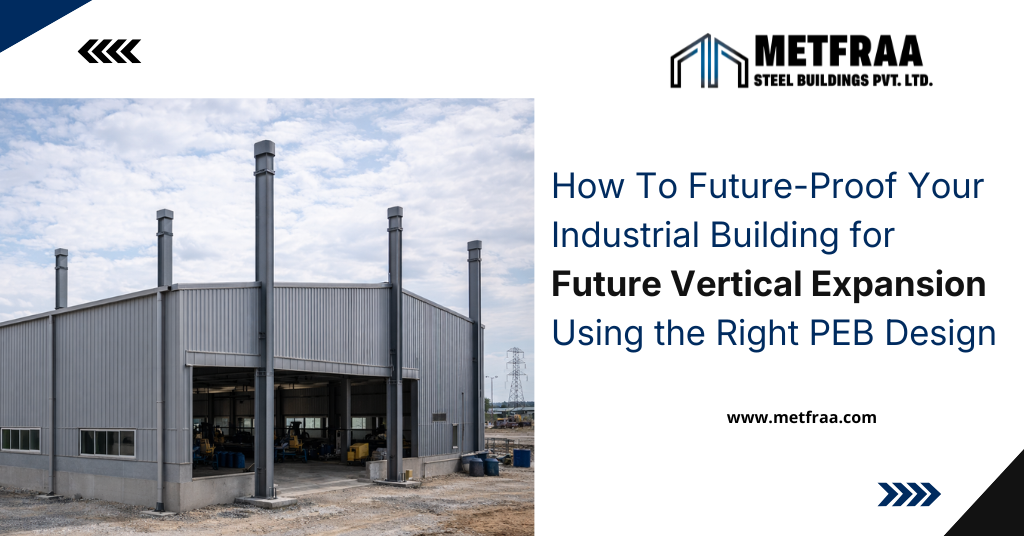
To properly prepare an industrial facility for vertical growth, it is essential to think through how your building will be used and what future changes might occur from the start of the design process. When you provide for future weight loads on the structure, multiple floor plates, and potential future operational changes at the time of initial design, you can significantly improve your ability to successfully expand your structure vertically.
The key to preparing an industrial building for vertical growth is to think ahead during the design stage. Planning for future floors, heavier loads, and changing operational needs from the start makes expansion far easier later on. This is where the right pre-engineered building (PEB) design makes a real difference. A well-planned PEB system allows industrial facilities to expand vertically in a safe and efficient way, with minimal disruption to day-to-day operations, whenever the need arises.
Understanding Vertical Expansion in an Industrial Building
What Vertical Expansion Means for an Industrial Building
Vertical growth is essentially the ability to increase usable square footage within your existing building footprint. For most industrial facilities, this includes one or more of the following options:
- Adding a mezzanine level for storage or production
- Creating multi-level processing or assembly area
- Supporting higher equipment/floor loads
- Enabling capacity growth without acquiring additional property/land
Unlike commercial buildings, vertical expansion in an industrial building must account for heavy machinery, dynamic loads, crane movements, and strict safety norms.These structural considerations are governed by national standards and engineering best practices defined under Indian building regulations such as those issued by the Bureau of Indian Standards (BIS)
Why Do Industrial Building Expansions Fail Without Planning?
Many expansion projects become costly or impractical because the original structure was never designed for vertical growth. Common reasons include:
- Columns and frames designed solely for the weight of current loading conditions
- Foundations engineered without consideration for future loading conditions
- Insufficient bracing systems to accommodate new height
- Retrofitted work requiring extended periods of downtime
Most if not all of these problems can be avoided through proper planning at the time of the initial development of your facility
Why PEB Is Ideal for Vertical Expansion of an Industrial Building
How a PEB Building Supports Future Vertical Growth
A PEB building is an engineered structural system designed for flexibility and precision. When planned correctly, PEB design allows engineers to:
- Leave excess load capacity in the frames and columns for future extension of the member connections.
- Design connections for future extensions of frame connections.
- Incorporate new floor levels into the structure without having to demolish all of the existing work.
Therefore, PEB systems are highly advantageous as they provide a long-term scalable option for industrial steel buildings.
PEB vs Conventional Design for an Industrial Building
Compared to traditional construction methods, PEB designed systems allow for:
- Predictable behaviour of the structure under loading conditions.
- Fast, accurate and tidy changes/modifications to the structure.
- Easier and less costly methods of strengthening at future stages.
- Lowest lifecycle cost when considering future expansion from the outset.
That’s why many of today’s modern industrial steel buildings are designed to be minimum expansion capable assets.
Key Structural Elements That Enable Vertical Expansion in an Industrial Building
Column and Frame Design for Vertical Expansion
Columns are the main part of a vertical expansion project. Future-ready designs typically have:
- Built-in load reserves in columns.
- Understanding of slenderness/buckling.
- Connection details to allow for future expansion.
This will give you an efficient initial cost and flexibility for the long term.
Foundation Planning for Vertical Expansion in an Industrial Building
Once the foundation is built, it is expensive and difficult to alter. A future-proof plan includes:
- Soil bearing capacity for expected increased loads.
- Larger base plates and anchor systems.
- Structural loadpaths for future floors.
Planning your foundation early is much less costly than having to build the foundation later on.
Floor Systems and Load Planning in an Industrial Building
Designing Mezzanine-Ready Structures in an Industrial Building
The installation of mezzanines creates additional loading and vibration requirements. Prior to construction, planning should include:
- Assumptions about future loads of storage and equipment
- Controlling deflection and vibration
- Clear spans to allow flexibility for layout
Industrial buildings constructed with steel frames will typically have high dynamic loads.
Crane and Equipment Load Integration
Vertical expansion must work alongside crane systems and heavy equipment. Planning should address:
- Future upgrades to crane capacity
- Combinations of vertical and crane loads
- Avoiding conflicts with existing or future floors and crane runways
Without this planning, future expansions will be extremely difficult to achieve and will cause disruption to operations.
Safety, Compliance, and Cost Benefits of Planning Ahead
By planning ahead in advance of vertical expansion will produce a variety of advantages for an industrial building:
- Meeting future fire safety and accessibility criteria
- Conformance to updated wind load and seismic criteria
- Minimising the cost of strengthening the existing structure for the future expansion
- Minimising production downtime
With respect to the cost aspect, planning ahead only increases marginally at the time of initial design but saves considerably from the future upgrades due to efficient planning.
Role of Expertise in Designing an Expansion-Ready Industrial Building
An experienced PEB specialist will help ensure that an owner knows how to best support their future operations using this type of building design by providing accurate load forecasting, system-level planning, and other services typically associated with the construction of a steel building.
At the same time, there is a difference between what a PEB will look like after it has been fabricated and what that same PEB will look like when it is constructed to accommodate future vertical additions. Because most PEB manufacturing companies currently use a traditional design approach that considers only the current load and does not account for future loads, owners often turn to companies like Metfraa Steel Buildings who can help them design an industrial building with future expansion in mind.
Conclusion:
As we look towards 2026, future-proofing an industrial building from the outset will be considered a strategic priority, not just an aesthetic decision. By designing for vertical additions, the ability for the industrial sector to expand is dependent upon how accurately the original design accounts for anticipated future load requirements.
To learn more about what it takes to develop a future-ready PEB design or to receive assistance with planning for vertical expansion, Contact Metfraa Steel Buildings for assistance from PEB professionals.
Frequently Asked Questions ( FAQ):
Q.Can an industrial building be designed for future vertical expansion?
A.Yes. With the right PEB design, an industrial building can be planned to support future floors and higher loads safely.
Q.Is PEB suitable for multi-level industrial buildings?
A.Yes. PEB systems are well-suited for multi-level industrial use when vertical expansion is planned during design.
Q.Does planning for vertical expansion increase initial cost?
A. Only marginally. The additional cost at the design stage is much lower than the cost of retrofitting later.
Q.Can vertical expansion be done without stopping operations?
A. With proper planning, expansion work can often be phased to minimise disruption.