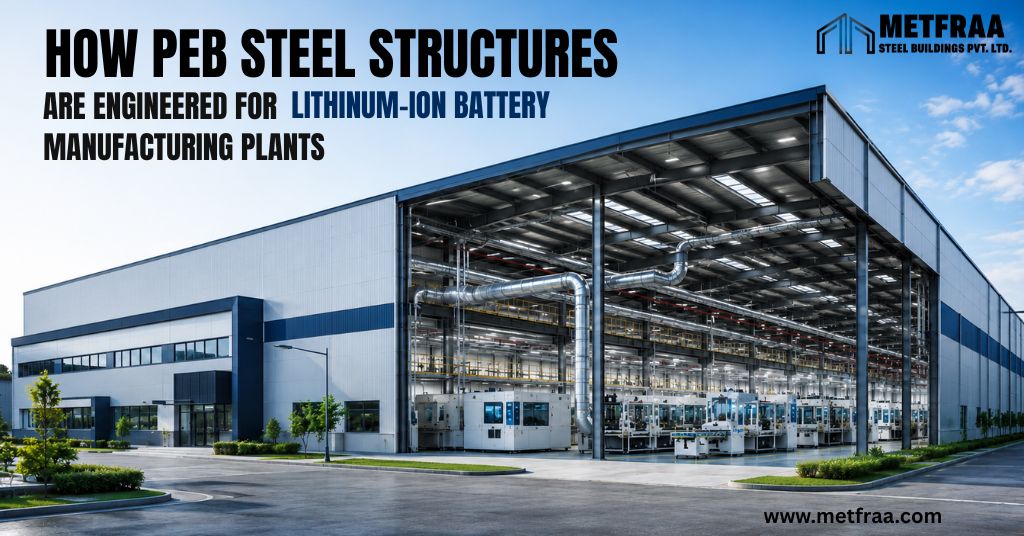
PEB steel structures for lithium-ion battery manufacturing plants are becoming increasingly important as the global transition toward electric vehicles, renewable energy storage, and advanced electronics accelerates the demand for lithium-ion batteries. As a result, manufacturers racing to increase production capacity require facilities that offer far more than conventional industrial buildings.
They need highly controlled environments capable of supporting precision manufacturing, heavy machinery, strict safety standards, and future production expansion.
For battery manufacturers planning new production facilities, the building structure itself needs to accommodate changing production requirements, large equipment layouts, service infrastructure, and future expansion. Metfraa Steel Buildings Pvt. Ltd. provides customized PEB and steel building solutions for industrial applications, with capabilities extending from design and fabrication to project execution.
This article explores how PEB steel structures are engineered to meet the evolving demands of one of the world’s fastest growing manufacturing industries.
Why Lithium-Ion Battery Plants Have Unique Structural Requirements
Battery manufacturing involves multiple specialized processes, including electrode preparation, cell assembly, electrolyte filling, formation, aging, module assembly, and quality testing. Each stage demands precise environmental control and specialized infrastructure.
Unlike standard manufacturing units, lithium-ion battery facilities require:
- Cleanroom compatible production areas
- Temperature and humidity-controlled environments
- Vibration sensitive equipment foundations
- Heavy process machinery support
- Chemical storage zones
- Fire resistant construction
- High-capacity electrical infrastructure
- Future production line expansion capability
Therefore, these requirements directly influence how the building itself is engineered.
For a PEB specialist, this means the structural building must be planned around the operational requirements of the manufacturing process rather than treated as a standard industrial shell. Metfraa’s approach to customizing steel structural buildings according to individual industry requirements is relevant when developing this type of specialized industrial facility.
Engineering the Structural Framework for Heavy Manufacturing Equipment
Lithium-ion battery manufacturing lines include numerous heavy and precision machines such as:
- Mixing equipment
- Coating machines
- Roll pressing systems
- Dry rooms
- Formation equipment
- Automated assembly lines
- Robotic handling systems
PEB engineers calculate:
- Equipment dead loads
- Dynamic operational loads
- Crane loads (if applicable)
- Mezzanine loads
- Future machinery additions
The structural members, including primary frames, rafters, and columns, are optimized using advanced structural analysis software to ensure maximum stability while minimizing unnecessary steel consumption.
Additionally, proper load distribution reduces structural deflection, which is critical for precision manufacturing equipment.
Metfraa’s PEB engineering and fabrication capabilities can be applied to the structural requirements of industrial production buildings where equipment loads, building dimensions, and operational layouts need to be considered during the design stage.
Column Free Production Areas for Automated Manufacturing
Modern battery production depends heavily on automation.
Automated Guided Vehicles (AGVs), conveyor systems, robotic arms, and continuous production lines require uninterrupted movement throughout the facility.
PEB systems enable:
- Large clear spans
- Minimal internal columns
- Flexible production layouts
- Easy equipment relocation
- Better logistics flow
As a result, manufacturers gain greater flexibility to redesign production lines as technology evolves by eliminating unnecessary structural obstructions.
Supporting Cleanroom and Dry Room Construction
One of the most critical components of battery manufacturing is the dry room, where moisture sensitive processes take place.
PEB structures are engineered to support:
- Insulated wall systems
- Vapor barriers
- Cleanroom ceiling grids
- HVAC ducting
- Air handling units
- Filtration systems
In addition, the roof framing is designed to accommodate suspended cleanroom ceilings and extensive mechanical systems without compromising structural performance.
This integration helps maintain strict environmental conditions essential for lithium-ion cell quality.
Roof Engineering for Massive HVAC Systems
Battery plants consume enormous amounts of air conditioning.
Maintaining controlled humidity sometimes below 1% relative humidity is essential during electrode and electrolyte processing.
As a result, roofs must support:
- Heavy AHUs
- Chillers
- Ventilation equipment
- Exhaust systems
- Process piping
- Solar panels (optional)
Engineers carefully evaluate:
- Point loads
- Wind uplift
- Equipment vibration
- Maintenance access
The roof system is strengthened wherever rooftop mechanical equipment is installed while maintaining overall structural efficiency.
Metfraa also provides roofing systems as part of its building solutions, making roof engineering and integration an important consideration when developing industrial facilities that require extensive rooftop services and equipment.
Designing for High Electrical Infrastructure
Battery manufacturing plants have exceptionally high-power requirements.
PEB structures are designed to accommodate:
- Cable trays
- Bus ducts
- Transformer platforms
- Control rooms
- Utility corridors
- Electrical mezzanines
Furthermore, structural coordination during the design stage ensures that electrical systems integrate seamlessly without requiring costly modifications after construction.
Fire Safety Integrated into Structural Engineering
Although steel itself is noncombustible, battery manufacturing facilities require additional fire protection due to the nature of lithium-ion materials.
PEB engineering includes provisions for:
- Fire rated wall assemblies
- Fire resistant coatings
- Smoke ventilation systems
- Emergency exits
- Firewater piping supports
- Explosion relief panels (where required)
In addition, structural layouts ensure proper compartmentalization to reduce the spread of fire between production areas.
Corrosion Protection for Chemical Processing Areas
Battery manufacturing involves chemicals that may create corrosive environments in specific sections of the plant.
Engineers select protective systems such as:
- Hot dip galvanization
- High-performance epoxy coatings
- Specialized paint systems
- Corrosion resistant fasteners
Therefore, the appropriate protection method depends on the plant’s operating conditions, ensuring long service life with reduced maintenance.
Crane Systems for Material Handling
Many battery plants use overhead cranes for transporting:
- Steel coils
- Electrode rolls
- Heavy machinery
- Process equipment
- Raw material pallets
PEB frames can be engineered to support:
- Single girder cranes
- Double girder cranes
- Gantry systems
- Maintenance cranes
As a result, proper crane beam integration minimizes structural vibration and ensures safe material handling operations.
Designing for Future Expansion
The battery industry evolves rapidly.
Manufacturers frequently expand production capacity to meet growing demand.
PEB buildings are often engineered with expansion in mind by incorporating:
- Expandable end walls
- Modular framing systems
- Additional foundation provisions
- Future crane extensions
- Utility expansion corridors
As a result, this approach allows production capacity to increase without major disruption to existing operations.
Energy Efficient Building Envelope
Battery production facilities operate continuously, making energy efficiency a significant operational concern.
Modern PEB buildings support:
- High-performance insulated panels
- Thermal roof systems
- Daylighting solutions
- Ridge ventilators
- Solar ready roof structures
- Energy efficient cladding systems
Consequently, these features reduce HVAC loads and improve long-term operational savings.
BIM and Digital Engineering Improve Project Accuracy
Today’s lithium-ion battery plants involve multiple disciplines working simultaneously.
PEB manufacturers increasingly use Building Information Modeling (BIM) for:
- Structural coordination
- Mechanical integration
- Electrical routing
- Clash detection
- Construction sequencing
- Facility management planning
As a result, digital engineering significantly reduces installation conflicts and shortens project delivery timelines.
Faster Construction for Faster Production
Speed marketing is one of the biggest advantages of PEB construction.
Compared to conventional industrial buildings, PEB systems offer:
- Factory fabricated components
- Faster on-site erection
- Reduced labor dependency
- Better quality control
- Minimal material wastage
- Predictable project schedules
Therefore, for battery manufacturers aiming to begin production quickly, this accelerated construction process provides a substantial competitive advantage.
Sustainability Benefits
As the battery industry supports clean energy initiatives, manufacturers increasingly seek environmentally responsible infrastructure.
PEB steel structures contribute through:
- Recyclable steel components
- Reduced construction waste
- Lower embodied carbon compared to many conventional systems
- Energy efficient building envelopes
- Solar integration capability
- Long service life
Moreover, these factors help organizations align with global sustainability goals while improving operational efficiency.
Why PEB Structures Are Ideal for Lithium-Ion Battery Manufacturing
Overall, a well-engineered PEB system delivers far more than a factory shell. It creates a manufacturing environment capable of supporting precision equipment, maintaining strict environmental conditions, accommodating future technological changes, and meeting demanding safety standards.
Key advantages include:
- Large column free production spaces
- Support for cleanrooms and dry rooms
- Heavy equipment load capacity
- Integrated HVAC and electrical infrastructure
- Fire and corrosion protection
- Faster project completion
- Expansion ready structural design
- Lower lifecycle maintenance costs
- Sustainable construction practices
For manufacturers investing in next generation battery production, these capabilities make PEB steel structures one of the most practical and future ready building solutions available. PEB steel structures for lithium-ion battery manufacturing plants provide the flexibility needed to accommodate heavy equipment, specialized production areas, and future expansion.
Conclusion
The rapid growth of the lithium-ion battery industry requires manufacturing facilities that are efficient, adaptable, and built to exacting technical standards. PEB steel structures for lithium-ion battery manufacturing plants provide the engineering flexibility needed to support sophisticated production processes, advanced automation, controlled environments, and future expansion without compromising construction speed or structural reliability.
From heavy equipment support and cleanroom integration to energy efficiency and scalable layouts, every aspect of a PEB can be tailored to battery manufacturing needs. Metfraa Steel Buildings Pvt. Ltd. provides customized PEB solutions for industrial facilities. Contact us today To discuss your battery manufacturing facility requirements.
Frequently Asked Questions (FAQs)
1. How are PEB structures engineered to support lithium-ion battery manufacturing equipment?
PEB structures are engineered for equipment dead loads, dynamic loads, crane loads, mezzanines, and future machinery, while maintaining structural stability and suitable production spaces.
2.PEB steel structures be expanded as battery production grows?
PEB structures can be engineered with expandable framing and provisions for future production lines, utilities, and equipment, allowing lithium-ion battery plants to increase capacity with minimal disruption.
3. How can PEB structures support AHUs in lithium-ion battery plants?
PEB structures can accommodate AHUs, HVAC networks, service platforms, and equipment support while maintaining efficient production spaces and structural stability.
6. Does Metfraa Steel Building have experience with AHU-related industrial structures?
Metfraa Steel Building AHU Factory project for Takenaka India Pvt. Ltd., Chittoor, involved integrated steel structures, equipment support, HVAC networks, service platforms, and multi-tier walkways. This experience is relevant to technically demanding manufacturing facilities, though the project was not a battery plant.