As companies continue to expand their warehouses in 2025, they face the challenges that result from this rapid growth in logistics, e-commerce, and manufacturing. These industries all require companies to rapidly expand their warehouse capacity for storage, automation, and distribution.
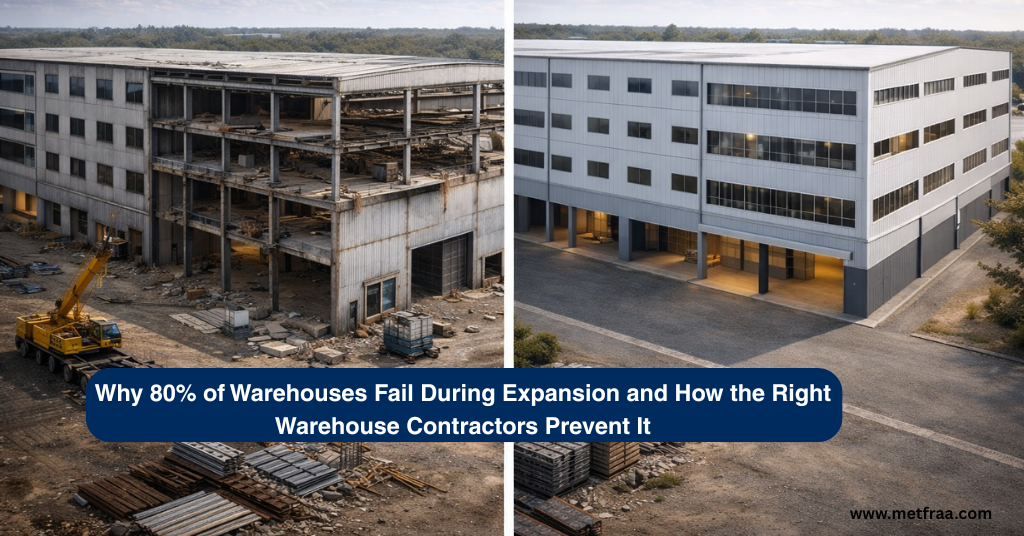
The reality is that approximately 80% of warehouse expansions fail or become structurally unsafe during this rapid growth phase. The reason for this astonishing statistic is not due to being unlucky; rather, it is a direct result of poor planning, weak structural engineering, and selecting the wrong warehouse construction contractors at the beginning of the project.
This blog explores the various reasons why warehouse expansions often fail, identifies common planning and construction mistakes that contribute to warehouse failure, and highlights the role of reputable warehouse construction contractors, particularly in high-growth industrial zones such as Chennai.
Why Warehouse Expansion Fails in 80% of Cases
Warehouses constructed between 2010-2020 face serious difficulties because their constructions do not accommodate the height, volume, and loading methods expected in 2025. Below are some ways that warehouses fail when they are expanded:
1. Poorly Conceived and Improperly Designed
A commonly occurring problem with warehouse expansion is that it has a layout configured based on current demand without any foresight for potential demands.
Some of the most common layout mistakes made while designing warehouses are as follows:
- Position of docks/drives cannot expand due to blockage by future bays, spacing of the columns prevents racking from being expanded, vertical growth and/or mezzanines are not permitted by design, and finally, there is no setback available for future structural additions.
- It is recommended to design for future expansions at the time of the original design, rather than after the completion of construction.
2. Engineering Constraints and Structural Failure
The second most common cause of warehouse failure is that the original construction did not take into consideration future expansion.
The following represent how errors in the construction of a warehouse may prevent future expansions:
- Too small a footing, low-load bearing columns, improper spacing of bays, weak bracing and purlins, inadequate future connection points, and the roof slope not allowing for future extensions.
- Once errors such as the above have occurred and the structures are in place, fixing these deficiencies is very expensive and fraught with considerable risk.
3. MEP and Fire Systems Cannot be Expanded
Even if you can expand your structure, likely, you will likely not be able to expand all of your services (utilities).
- Electrical panels without any spare load capacity (zero available capacity)
- Hydrant/sprinkler systems that have no room for additional zones
- Drainage systems are not capable of supporting additional roof area.
- No extra (available) conduits for new wiring/equipment
Businesses typically do not properly evaluate their MEP needs before they are faced with the inability to expand as a business.
How Poor Warehouse Contractors Cause Expansion Failure
The majority of factors preventing the expansion of warehouses can be attributed to the original contractor’s work. Some of the biggest problems include:
1. The lack of future-proofing in structural design
An inexperienced contractor will neglect to include the following in their structural design:
- load expansion studies
- allowances for future bay extensions
- soil capacity studies
- wind pressure and cyclone loads
- Long-term engineering planning for Pre-engineered buildings
All of these failures will create a strong warehouse on paper, but not one that is strong enough for future expansion.
2. Because contractors often use low-cost building materials to construct warehouses:
- thin roofing sheets
- low-grade steel
- weak anchor bolts
- substandard purlins
These materials will greatly reduce the structural life of the building and leave very little room for growth.
3. Missing documents will stop all future expansion of a warehouse
Without the following documents, an engineer cannot determine how far out the warehouse can expand safely:
- structural drawings
- foundation drawings
- material grade certificates
- fabrication drawings
- MEP designs
This forces the company to either construct a new warehouse or take the risk of an unsafe building.
How the Right Warehouse Contractors Prevent Expansion Failures
The most successful warehouse contractors will have expansion in mind from the beginning, and this is where the biggest contrast can be seen.
1. Engineering-first design approach:
- Pedestals are spaced appropriately for future bays.
- The foundation has excess load capacity built into it.
- The slope of the roof allows continuous extension.
- The bracing will not block the extension area.
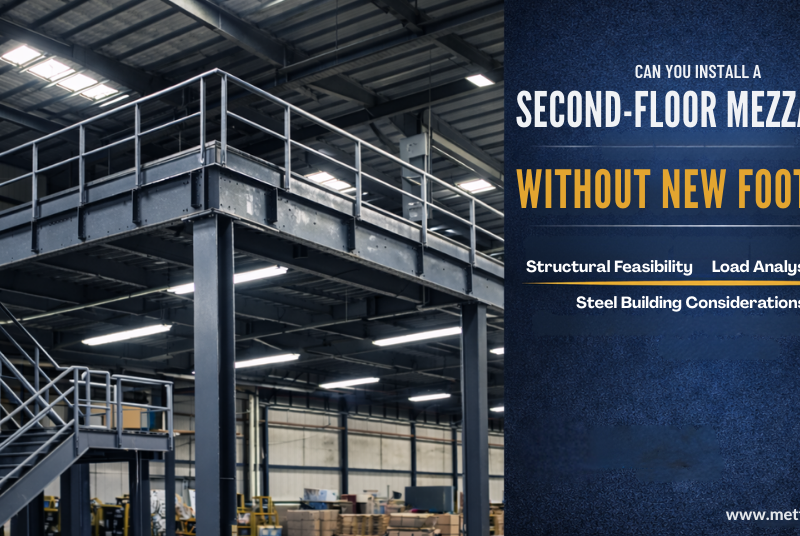
- Mezzanine plans align with future business expansion.
With these considerations in place, the expansion process will be simple and will require only extending, not redesigning, the warehouse.
2. Future-Ready MEP, Fire, and Utility Systems
The most experienced contractors will build:
- Electrical panels with spare breaker space to allow for future growth.
- Extra sprinkler and fire hydrant provisions in the event of future expansion
- Trenches and conduits for future wiring and cabling, which will reduce the time needed to complete an expansion.
- Sizing of drain lines for future rainfall on the roof
3. Using High-Strength Steel and Certified PEB Engineering
Certified warehouse building contractors build PEB buildings in a modular fashion. This means:
- New bays will bolt directly onto the existing rafters.
- New purlins will integrate into the existing structure without modifications.
- Structural alignment remains perfect throughout the entire building.
- No demolition will be necessary.
Companies like Metfraa Steel Buildings, known for precision engineering, strong load calculations, and expansion-ready PEB design, create warehouses that grow naturally with business demand.
Why Warehouse Contractors Chennai Matter for South India
Chennai is one of the fastest-growing warehousing clusters in Asia, but local conditions make expansion challenging.
1. Soil, Climate & Coastal Engineering Challenges
Experienced warehouse contractors in Chennai understand:
- Cyclonic wind loads
- High coastal humidity (corrosion risk)
- Varying soil conditions (clay, silt, red soil)
- Heavy monsoon drainage needs
Without this expertise, expansion becomes structurally unsafe.
2. Chennai-Specific Compliance & Approvals
Warehouse construction in Chennai requires navigating:
- CMDA/DTCP rules
- Fire & Safety NOC
- Industrial zone approvals
- Environmental compliance
Local contractors expedite approvals and prevent legal delays.
10 Warning Signs Your Warehouse Will Fail During Expansion
Use this checklist to evaluate risk:
- No structural drawings
- No bay extension provision
- Very tight column spacing
- Weak flooring
- Improper roof slope alignment
- Undersized electrical panel
- No spare fire zones
- Poor drainage design
- Low-grade steel
- Early signs of corrosion
Seeing three or more signals? Expansion will be difficult or costly.
How to Choose the Right Warehouse Contractors for Expansion-Ready Warehouses
Technical Capabilities
- Structural calculations
- Soil load analysis
- PEB engineering approvals
- CAD detailing & drawings
Execution Strength
- Skilled site engineers
- QA/QC protocols
- Project timelines
- MEP & fire planning expertise
Commercial Transparency
- Clear BOQ
- Material grade confirmation
- Warranty and AMC terms
A contractor who meets all three criteria will deliver an expansion-ready facility.
Conclusion
Warehouse expansion should never feel like starting from scratch. With the right warehouse contractors, your building becomes a scalable, future-ready asset that grows with your business safely and cost-efficiently.
Whether you plan to add new bays, increase racking, install mezzanines, or scale operations, your success depends entirely on engineering foresight and contractor expertise. Contact us to build smart and expand confidently.
Frequently Asked Questions (FAQ):
1. Why do warehouses fail during expansion?
Most failures happen due to weak engineering, undersized foundations, and poor planning during initial construction.
2. How can warehouse contractors help?
They design expansion-ready structures with scalable foundations, roof systems, and MEP capacity.
3. Are PEB warehouses easier to expand?
Yes.PEB steel frames allow modular, bolt-on extensions with minimal disruption.
4. What should I check before expanding?
Confirm structural drawings, column spacing, load capacity, fire zoning, and electrical availability.
5. Why does Chennai need specialized contractors?
Local experts understand cyclone loads, corrosion risks, and CMDA/DTCP regulations essential for safe expansion.